

Imagine spending three years visiting seven different specialists, only to find out that your symptoms don't fit into one single box. For many, this isn't a hypothetical; it's the reality of living with autoimmune overlap syndromes is a complex medical condition where a person meets the diagnostic criteria for two or more distinct connective tissue diseases simultaneously or sequentially . When your body attacks its own tissues in multiple ways, the medical puzzle becomes significantly harder to solve. The real danger isn't just the diseases themselves, but the diagnostic gaps and fragmented care that often follow.
What Exactly is an Overlap Syndrome?
In the world of rheumatology, most diseases have a specific "checklist" for diagnosis. But what happens when you check the boxes for two different diseases? That is an overlap syndrome. It is more common than you might think-roughly 25% of people diagnosed with one connective tissue disease (CTD) will develop features of another within a decade. This isn't just a quirk of biology; it's a significant clinical challenge that requires a shift in how we approach treatment.
The most well-known version is Mixed Connective Tissue Disease (also known as MCTD), first described in 1972. It’s a unique blend of systemic lupus erythematosus (SLE), scleroderma, myositis, and rheumatoid arthritis. Unlike a simple "co-occurrence" of two diseases, MCTD is often viewed as its own entity, marked by very high levels of anti-U1 ribonucleoprotein (RNP) antibodies.
The Different Faces of Overlap Syndromes
Not all overlap syndromes look the same. Depending on which antibodies are present, the symptoms and risks change drastically. For instance, Antisynthetase Syndrome typically focuses on the lungs and muscles, with about 85% of patients experiencing myositis and 65-70% dealing with interstitial lung disease. You might see "mechanic's hands"-thickened, cracked skin on the fingertips-which is a classic red flag for this condition.
Then there is the PM/Scl overlap syndrome, which blends polymyositis and scleroderma. In these cases, skin tightening is common in 75% of patients, often accompanied by muscle inflammation. When the complexity scales even further, we see Multiple Autoimmune Syndrome (MAS), where three or more autoimmune diseases coexist. This can range from a combination of Sjögren's and rheumatoid arthritis to more severe clusters involving type 1 diabetes and Addison's disease.
| Syndrome | Primary Antibody Marker | Key Physical Features | Common Complication |
|---|---|---|---|
| MCTD | Anti-U1-RNP | Raynaud's, puffy hands, arthritis | Pulmonary Hypertension |
| Antisynthetase | Anti-Jo-1 | Myositis, mechanic's hands | Interstitial Lung Disease (ILD) |
| PM/Scl Overlap | Anti-PM/Scl | Skin tightening, muscle weakness | Interstitial Lung Disease (ILD) |
The Diagnostic Struggle: Why It Takes So Long
If you feel like you're shouting into a void during doctor visits, you aren't alone. About 45% of overlap patients face diagnostic delays longer than 18 months. Why? Because most medical training focuses on "textbook" cases. When a patient has scleroderma-like skin changes but lacks the typical digital ulcers, a doctor might dismiss the diagnosis of scleroderma, not realizing they are looking at a PM/Scl overlap.
Even the experts struggle. The American College of Rheumatology (ACR) and European League Against Rheumatism (EULAR) have great criteria for single diseases, but there is no universally accepted "overlap checklist." This creates a grey area where patients are often labeled with "undifferentiated connective tissue disease" (UCTD) for years before a clearer pattern emerges.
The Danger of Fragmented Care
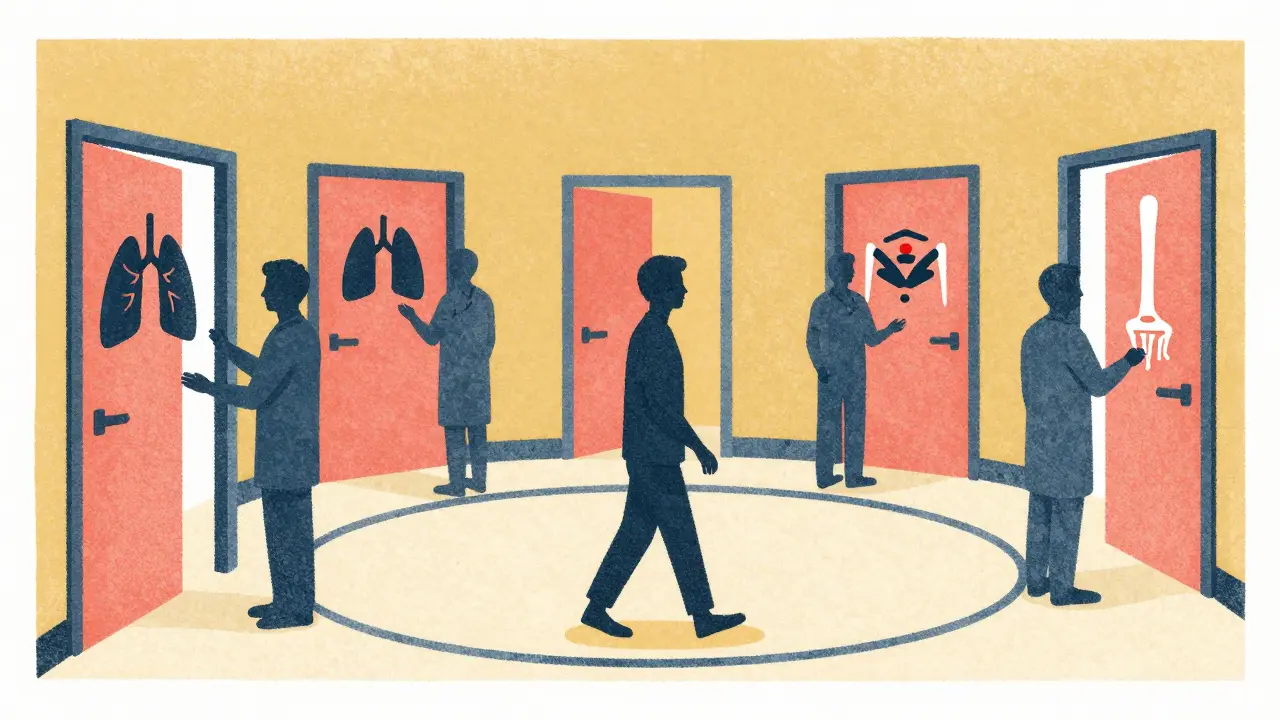
One of the biggest hurdles isn't the medicine-it's the logistics. Many patients end up in a "specialist loop." You see a rheumatologist for lupus, a pulmonologist for your lungs, and a dermatologist for your skin. The problem is that these doctors rarely talk to each other. This fragmentation leads to a dangerous situation called polypharmacy, where a patient might be taking three or more heavy immunosuppressants without a single doctor overseeing the total drug burden. This increases the risk of opportunistic infections, which occur in nearly 28% of patients on triple therapy.
The solution is a coordinated care model. Data from the Cleveland Clinic shows that having a dedicated care coordinator can reduce hospitalizations by 35%. Instead of the patient acting as the messenger between doctors, a coordinator ensures the pulmonologist knows exactly what the rheumatologist prescribed, preventing dangerous drug interactions and redundant testing.

Modern Treatment Strategies and Precision Medicine
Treatment is no longer about just "dampening" the immune system. It's about target-specific therapy. The baseline usually involves corticosteroids like prednisone and a primary immunosuppressant such as methotrexate or mycophenolate mofetil. However, for those with severe lung involvement, rituximab-a B-cell depletion therapy-has shown success in stabilizing lung function in 60-70% of cases.
We are now moving toward a "treat-to-target" approach. Instead of just treating symptoms, doctors are aiming for specific metrics: keeping forced vital capacity above 80% for lung health or maintaining a modified Rodnan skin score below 15 for skin elasticity. The future looks even more precise, with AI algorithms now able to predict the development of overlap syndromes with 82% accuracy up to a year before the clinical symptoms fully manifest.
Navigating Your Care Journey
If you suspect you have overlapping conditions, the most important step is to move from fragmented care to a multidisciplinary center. Look for clinics that specifically mention "connective tissue diseases" and provide a single point of contact for your care. Don't be afraid to ask your doctors, "How does this medication for my skin affect my lung treatment?"
Keep a detailed log of your symptoms and a master list of every medication and dosage. This simple habit reduces the risk of prescription errors and helps your team spot patterns that a single-specialty doctor might miss. Remember, the goal isn't just to treat a disease-it's to manage your overall health across all affected systems.
What is the difference between an overlap syndrome and having two separate autoimmune diseases?
While they look similar, an overlap syndrome often involves a blended set of features that don't fully satisfy the criteria for two separate diseases but create a distinct clinical entity (like MCTD). Having two separate diseases usually means you meet the full, distinct diagnostic criteria for both, whereas overlap syndromes often present as a "mixed" phenotype.
Which antibodies are the most important for diagnosing overlap syndromes?
The most critical markers include anti-U1-RNP for Mixed Connective Tissue Disease, anti-Jo-1 (and others like PL-7 and PL-12) for Antisynthetase Syndrome, and anti-PM/Scl for polymyositis/scleroderma overlap. High titers of these antibodies, combined with specific clinical symptoms, are key to a correct diagnosis.
Why is interstitial lung disease (ILD) so common in these syndromes?
Many of the diseases that overlap, such as scleroderma and polymyositis, have a high affinity for attacking lung tissue. Because overlap patients have multiple "pathways" of inflammation active at once, the lungs are often a primary target, affecting up to 70% of those with antisynthetase syndrome.
Can overlap syndromes be cured?
Autoimmune diseases are generally chronic, meaning there is no "cure" that removes the condition entirely. However, they can be managed effectively. The goal is "minimal disease activity" (MDA), where symptoms are controlled and organ damage is prevented through a combination of immunosuppressants and lifestyle changes.
What are the risks of taking multiple immunosuppressants?
The primary risk is over-suppression of the immune system, which makes you vulnerable to opportunistic infections. Additionally, combining different drugs can lead to liver toxicity or kidney strain. This is why care coordination is vital-to balance the need for disease control with the need to maintain basic immune function.

