
How Patents Keep New Drugs Coming
Imagine a company spends 12 years and over $2.6 billion to develop a new cancer drug. They test it on thousands of patients, navigate endless FDA reviews, and finally get approval. Then, the moment it hits the market, another company copies it and sells it for 10% of the price. Would you invest in that kind of business? Probably not. That’s why patent law exists - to make sure the companies taking huge risks to create new medicines actually get a chance to recover their costs and keep innovating.
The U.S. system for balancing innovation and access is built on the Hatch-Waxman Act of 1984. This law didn’t just tweak the rules - it rewrote the entire game between brand-name drugmakers and generic manufacturers. Before Hatch-Waxman, brand companies could legally block generics from even starting development until their patents expired. That meant patients waited years longer for affordable versions of life-saving drugs. The law changed that by letting generic companies begin research early - but with clear rules on when they could actually sell their versions.
The Two Clocks: Patent Time and Regulatory Time
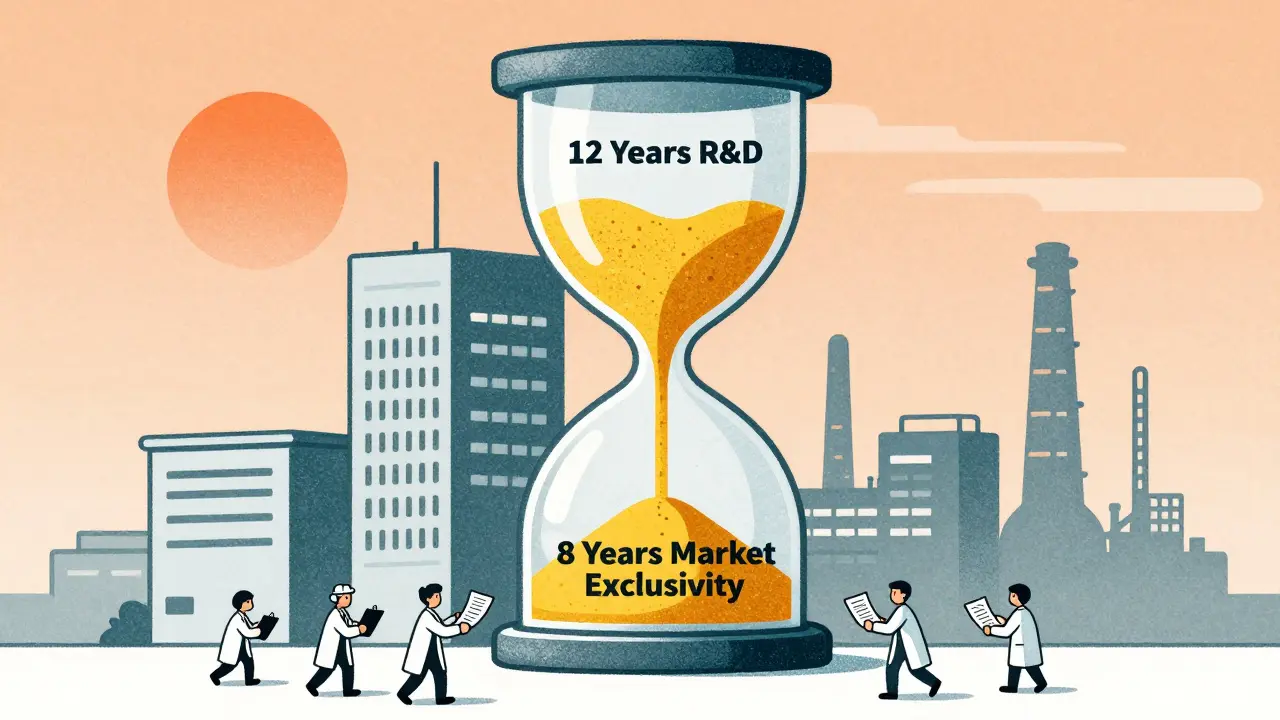
Pharmaceutical patents last 20 years from the date they’re filed. Sounds simple, right? But here’s the catch: drug development takes 10 to 12 years just to get to market. That leaves only 8 to 10 years of real market exclusivity - not nearly enough to recoup billions in R&D. The Hatch-Waxman Act fixed this by allowing patent term restoration. If a drug lost three years to FDA review, the patent could be extended by up to five years to make up for it. This isn’t a loophole - it’s a designed incentive. Without it, no company would risk developing drugs that take over a decade to reach patients.
On top of that, the FDA grants its own kind of protection called regulatory exclusivity. For new chemical entities, that’s five years of market exclusivity - no generics allowed, even if the patent has expired. For orphan drugs (for rare diseases), it’s seven years. For certain pediatric studies, it’s six additional months. These aren’t patents. They’re separate legal shields. Together, they create a layered system where innovators get protected time to earn back their investment before generics can enter.
How Generics Get to Market - and Why It’s So Complicated
Generic companies don’t just copy a drug and slap on a new label. They have to prove their version is bioequivalent - meaning it works the same way in the body. To do that, they file an Abbreviated New Drug Application (ANDA) with the FDA. But here’s where the legal chess game begins.
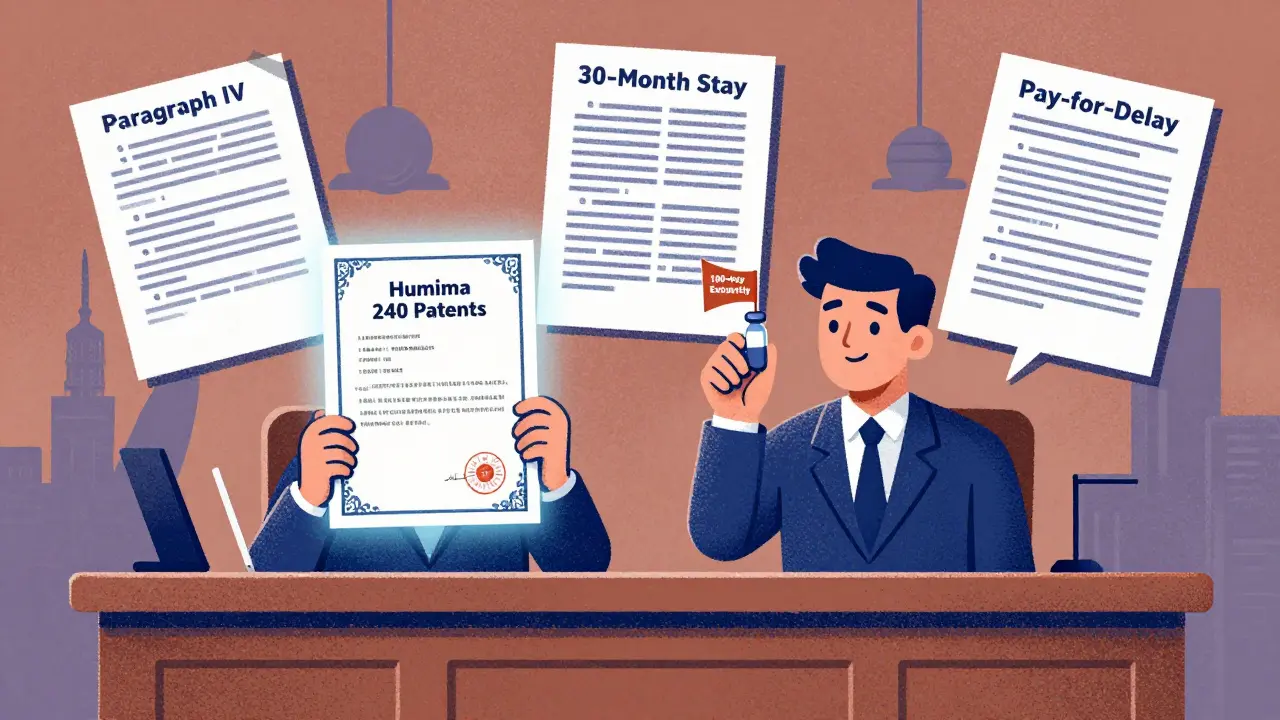
Brand companies list all their patents for a drug in the FDA’s Orange Book. Generics have to review this list and decide: do we challenge these patents? If they do, they file a Paragraph IV certification. This is a legal notice saying, ‘We believe your patent is invalid or we don’t infringe it.’
When that happens, the brand company has 45 days to sue. If they do, the FDA can’t approve the generic for 30 months - no matter if the patent is weak or strong. This is called the 30-month stay. It’s controversial because it gives brand companies a guaranteed delay, even if their patent might not hold up in court. But it also gives generics a clear signal: if you challenge, you’re signing up for a long, expensive fight.
And there’s a big prize for the first generic to challenge successfully: 180 days of exclusivity. During that time, no other generic can enter the market. Because of state laws that force pharmacists to substitute generics, this period can mean hundreds of millions in sales. That’s why companies like Teva and Mylan spend millions on legal teams - they’re betting they can win the first shot at the biggest payout.
The Price Drop That Saves Billions
Once generics enter, prices don’t just drop - they collapse. When Eli Lilly’s Prozac patent expired in 2001, the brand lost 70% of its U.S. market share within a year. Within six months, the price fell by 70%. By the time five generics were on the market, the price was down 90%. That’s not speculation - it’s documented history.
Today, generic drugs make up 91% of all prescriptions filled in the U.S. But they account for just 24% of total drug spending. In 2022 alone, they saved the system $373 billion. Think about that: for every $100 spent on prescriptions, $76 went to brand-name drugs. Without generics, that number would be close to $100. That’s why the Association for Accessible Medicines says generics prevented $2.2 trillion in healthcare costs between 2010 and 2020.
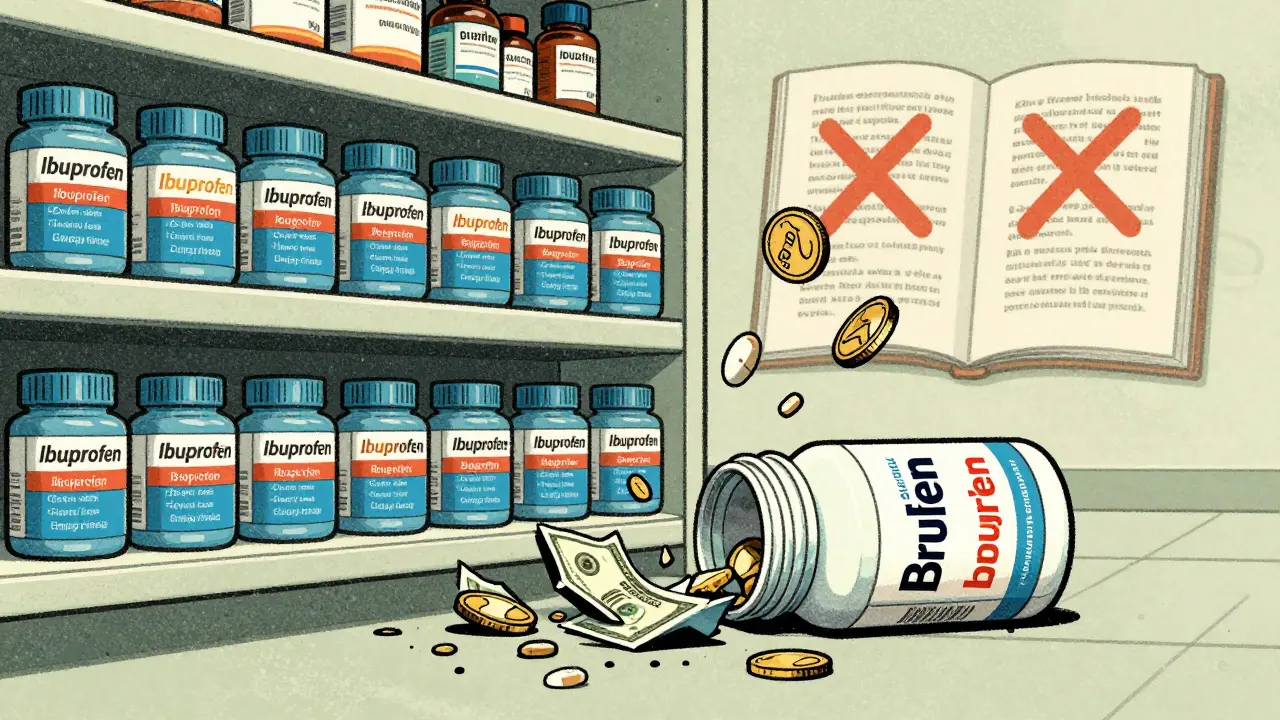
Take ibuprofen. Boots’ Brufen brand was the original. Once the patent expired in the 1980s, Advil, Motrin, and countless store brands flooded in. Today, you can buy 100 tablets for under $3. That’s not luck. That’s competition.
The Dark Side: Evergreening and Patent Thickets
But the system isn’t perfect. Some companies use tactics that stretch protection far beyond what Congress intended. One common trick is called ‘evergreening’ - filing new patents on minor changes: a new pill coating, a slightly different dosage schedule, or a new delivery method. These aren’t breakthroughs - they’re tweaks. But under the law, they can delay generics for years.
The most extreme example? Humira. The biologic drug for autoimmune diseases had over 240 patents filed across 70 families. That’s not innovation - that’s a legal wall. It kept biosimilars (the biologic version of generics) out of the U.S. until 2023, even though they were available in Europe since 2018. The European Commission has called these practices abusive under competition law. In the U.S., regulators have struggled to stop them.
Another tactic is ‘product hopping’ - switching patients from an older drug to a slightly modified version just before the patent expires. Then, they claim the old version is outdated. The 2022 CREATES Act tried to crack down on this by forcing brand companies to provide samples to generics, so they can test their products. But enforcement is still patchy.
What’s Next? Pay-for-Delay and Legal Uncertainty
One of the biggest threats to generic access isn’t patents - it’s secret deals. In ‘pay-for-delay’ agreements, a brand company pays a generic manufacturer to stay off the market. The FTC estimates this costs consumers $3.5 billion a year. These deals are now illegal under court rulings, but they still happen in disguised forms - like licensing deals or supply agreements.
There’s also legal chaos in the biologics space. The 2017 Amgen v. Sandoz case threw out key parts of the patent process for complex biologic drugs. The ‘patent dance’ - a step-by-step negotiation between brand and generic - was meant to reduce litigation. But after that ruling, companies started filing lawsuits earlier and more aggressively. No one knows how to fix it yet.
And now, the Patent Trial and Appeal Board’s inter partes review (IPR) process - a faster, cheaper way for generics to challenge patents - is under fire. Some courts are questioning whether it’s constitutional. If IPR gets shut down, it could take years longer for generics to enter the market.
Why This Matters to Everyone
This isn’t just about big pharma and big generics. It’s about whether you can afford your insulin, your asthma inhaler, or your blood pressure pill next month. The system works when patents protect real innovation - not when they’re used as tools to block competition. The Hatch-Waxman Act was designed to strike a balance. Today, that balance is tipping.
On one side, we need strong patents to keep new drugs coming. The average cost to develop a new cancer drug is now over $3 billion. Without patent protection, that investment vanishes. On the other side, we need generics to keep prices low. Without them, millions of Americans skip doses or choose between medicine and rent.
The future of this system depends on clear rules, fair enforcement, and transparency. The Orange Book needs to stop listing junk patents. Congress needs to close pay-for-delay loopholes. Courts need to stop letting companies game the system. And patients need to understand: the drug on your shelf today is only affordable because someone challenged a patent - and won.
How long do pharmaceutical patents last?
Pharmaceutical patents last 20 years from the filing date. But because drug development takes 10-12 years, the actual time a company has to sell the drug without competition is usually only 8-14 years. The Hatch-Waxman Act allows patent term restoration to make up for time lost during FDA review, extending exclusivity by up to five years.
What is the Orange Book and why does it matter?
The Orange Book is the FDA’s official list of approved drugs and their associated patents. Generic manufacturers must review it before filing their applications. If they want to challenge a patent, they must cite it in their Paragraph IV certification. It’s the roadmap for how generics enter the market - and how brand companies try to delay them.
Why do generic drugs cost so much less than brand-name drugs?
Generic manufacturers don’t have to repeat expensive clinical trials. They only need to prove their drug is bioequivalent to the brand version. That cuts development costs by 80-90%. They also face competition from other generics, which drives prices down further. A generic version of a drug often costs 80-85% less than the brand.
What is a Paragraph IV certification?
A Paragraph IV certification is a legal statement made by a generic drug company when filing an application with the FDA. It says they believe a brand’s patent is invalid or that their product doesn’t infringe it. This triggers a 45-day window for the brand company to sue - and if they do, the FDA can’t approve the generic for up to 30 months.
Do generics work as well as brand-name drugs?
Yes. The FDA requires generics to be bioequivalent - meaning they deliver the same amount of active ingredient into the bloodstream at the same rate as the brand. They must meet the same strict manufacturing standards. Millions of people take generics every day with the same results as brand drugs. The only differences are usually the color, shape, or inactive ingredients.
What’s the difference between a generic and a biosimilar?
Generics are exact copies of small-molecule drugs, like pills made from chemical compounds. Biosimilars are copies of complex biologic drugs, like injectables made from living cells. Because biologics are harder to replicate, biosimilars aren’t exact copies - they’re ‘highly similar.’ They still require extensive testing, and the approval process is longer and more expensive than for generics.
What is pay-for-delay and why is it controversial?
Pay-for-delay happens when a brand-name drug company pays a generic manufacturer to delay launching its cheaper version. These secret deals keep prices high and block competition. The FTC estimates they cost consumers $3.5 billion a year. Courts have ruled them illegal, but companies still find ways to disguise them as licensing or distribution deals.
How do patents affect drug prices in the U.S. compared to other countries?
The U.S. is one of the few countries that doesn’t regulate drug prices directly. In Europe and Canada, governments negotiate prices and often reject patents that don’t offer real innovation. In the U.S., patent law gives companies full control over pricing until generics enter. That’s why many drugs cost 2-3 times more here than elsewhere - even before generics become available.


Ed Mackey
I get why patents are needed, but man, seeing how Humira got 240 patents just to delay generics... that's not innovation, that's a legal loophole buffet. Pharma companies are playing chess while we're just trying to afford our meds.