
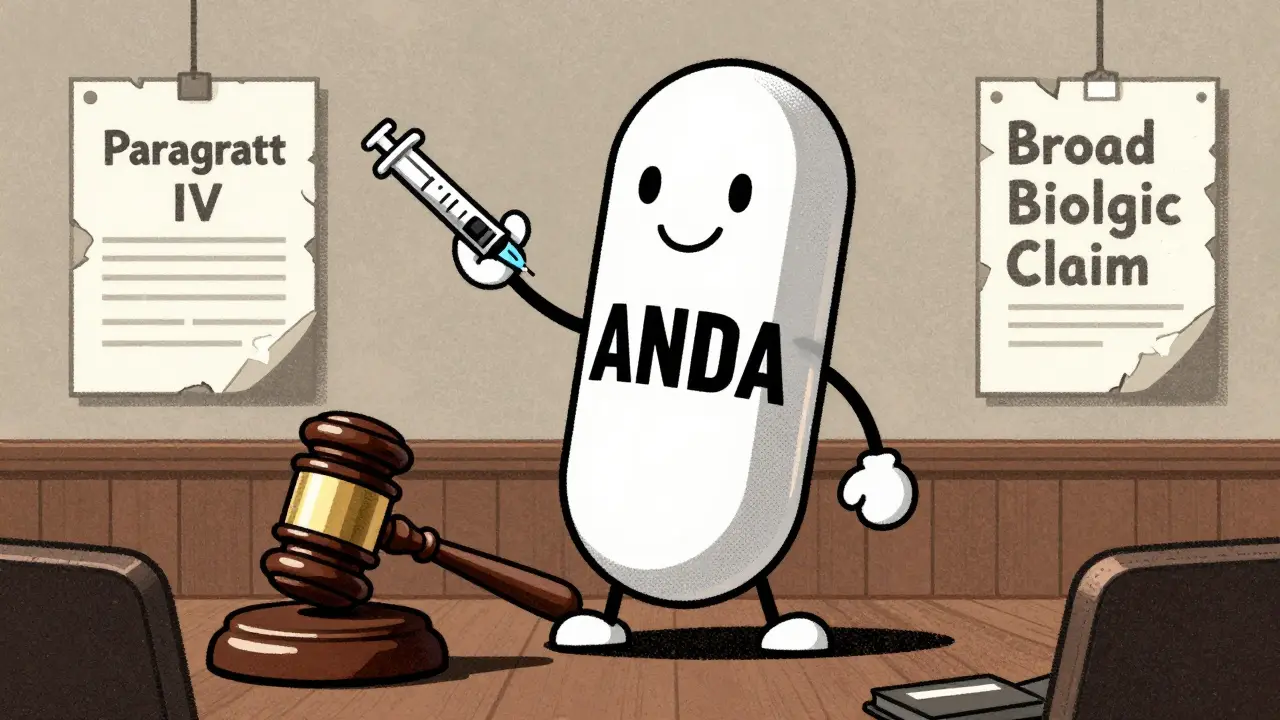
When a brand-name drug’s patent expires, you’d expect generic versions to hit the market right away. But that’s not what happens. Instead, a legal battle often begins - one that can delay cheaper drugs for years. These aren’t just courtroom dramas. They directly affect how much you pay for insulin, heart meds, or antibiotics. The system was designed to balance innovation with access, but over time, court decisions have shifted the balance - sometimes in favor of drugmakers, sometimes for generics. Here are the landmark rulings that changed everything.
How the Hatch-Waxman Act Set the Stage
In 1984, Congress passed the Drug Price Competition and Patent Term Restoration Act - better known as the Hatch-Waxman Act. It wasn’t meant to be a battleground. The goal was simple: let generic companies get their drugs to market faster, while giving brand-name makers extra time to recoup R&D costs. The law created a path for generics to file an Abbreviated New Drug Application (ANDA). Instead of redoing expensive clinical trials, they could prove their drug is bioequivalent. But there’s a catch: they must certify whether the brand’s patents are valid or won’t be infringed. That’s called a Paragraph IV certification. And when they do, it’s like ringing a legal alarm bell. The brand gets 30 months to sue. That’s where things get messy.
Amgen v. Sanofi: The End of Overly Broad Biologic Patents
Before 2023, some biologic drugmakers got away with patenting entire classes of molecules - like claiming “all antibodies that bind to this protein” - even if they only made 26 of them. That’s what Amgen did with its PCSK9 inhibitor, Repatha. Sanofi and Regeneron made similar drugs. Amgen sued, saying they infringed. The Supreme Court didn’t buy it. In Amgen v. Sanofi (2023), the justices ruled unanimously that a patent can’t cover millions of possibilities based on a few examples. The patent had to enable someone skilled in the field to make and use the full scope claimed. This wasn’t just about one drug. It was a wake-up call. Biotech companies had been relying on vague, sweeping claims to block competition. Now, they had to prove exactly how their invention worked. The result? A 34% drop in biologic patent filings with overly broad claims in the year after the decision (USPTO 2024 data). For generic makers, it meant clearer paths to market. For patients, it meant faster access to cheaper biologics like Humira alternatives.
Allergan v. Teva: The Rule That Protects First-File Patents
Here’s a sneaky tactic some brand companies used: file a new patent right before an older one expires. Then, claim the generic infringes the new one - even if the new patent expires earlier. That’s what Allergan tried with its glaucoma drug, Azopt. Teva had already filed an ANDA challenging the original patent. Allergan then listed a new patent in the Orange Book - one that expired in 2025, not 2028. They argued Teva had to wait until the new patent expired. The Federal Circuit shut that down in Allergan v. Teva (2024). The court ruled that a later-filed patent can’t be used to block a generic that’s already challenged the original patent. The logic? If the first patent is invalid or expired, the second one can’t be used as a legal shield. This decision stopped a common delay tactic. It meant generics could move forward even if brand companies tried to “evergreen” their patents with minor tweaks.
Amarin v. Hikma: When Labeling Becomes Infringement
Generics aren’t supposed to promote off-label uses. But what if their labeling hints at them? That’s what happened in Amarin v. Hikma (2024). Amarin’s drug Vascepa was approved only for severe triglyceride levels. Hikma’s generic label said “for use in lipid management” - a phrase that’s not technically off-label, but close enough to suggest broader use. Amarin argued that this wording induced doctors to prescribe it for unapproved conditions. The court agreed. It wasn’t about what Hikma said outright - it was about what a reasonable doctor would infer. This case set a new standard: generic labeling can trigger induced infringement if it’s crafted to nudge prescribers toward unapproved uses. Since then, 63% of brand companies have won similar claims (PTAB 2023 stats). For generic manufacturers, it means every word on the label is now a legal landmine. One wrong phrase - and you’re in court.
The 180-Day Exclusivity Rule: The Golden Ticket for Generics
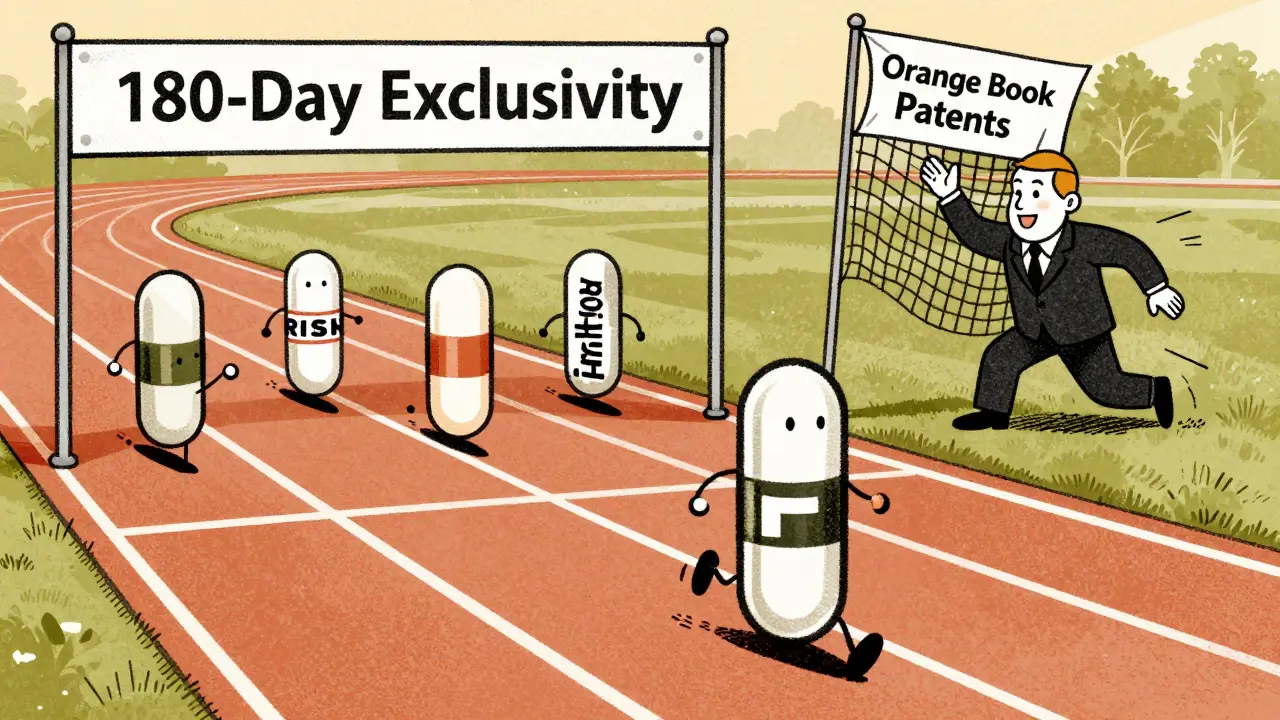
One of the most powerful tools in the generic playbook is the 180-day exclusivity period. The first company to file a Paragraph IV certification gets a head start - no other generic can enter the market for six months. That’s a huge incentive. It’s why companies like Teva and Mylan pour millions into legal teams just to be first. But it’s not foolproof. If the patent is invalidated, or if the first filer doesn’t launch within 75 days of court approval, the exclusivity can be lost. And if multiple companies file on the same day? The exclusivity is shared. This rule is why so many generics race to the courthouse. It’s also why drug prices don’t drop immediately after patent expiry - the market waits for that first challenger to act. Without this incentive, generic entry would be slower. With it, prices can plunge 80% within a year.
How IPRs Changed the Game
Before 2011, challenging a patent meant going to federal court - a slow, expensive process. Then came the America Invents Act, which created Inter Partes Review (IPR) at the Patent Trial and Appeal Board (PTAB). It was supposed to be a faster, cheaper alternative. And it was. By 2023, 78.3% of generic drug patent challenges used IPRs (Federal Circuit Bar Journal). Why? Because IPRs are decided in 12-18 months, not 3+ years. And they’re handled by patent experts, not juries. The success rate? About 65% of IPRs result in at least one patent claim being canceled. That’s why now, 92% of ANDA filers include an IPR challenge as part of their standard strategy (PTAB 2024). It’s not a backup anymore - it’s the main move.
Orange Book Listings: The Hidden Battlefield
The Orange Book isn’t just a directory. It’s a legal weapon. Brand companies must list every patent that could be infringed by a generic drug. But some list patents that shouldn’t be there - ones that cover delivery methods, packaging, or dosage forms that have nothing to do with the active ingredient. The FDA started cracking down in 2022 with new guidance on “Improperly Listed Patents.” Still, companies keep trying. In 2024, the Federal Circuit ruled in Teva v. ProAir that listing a patent for an inhaler device - not the drug itself - was improper. That decision forced companies to be more precise. But the system is still gamed. A 2024 survey found 58% of industry professionals say Orange Book listings have become “more complex and litigious.” And with 2,147 ANDA cases filed in 2023 alone, the list of disputed patents keeps growing.
What This Means for You
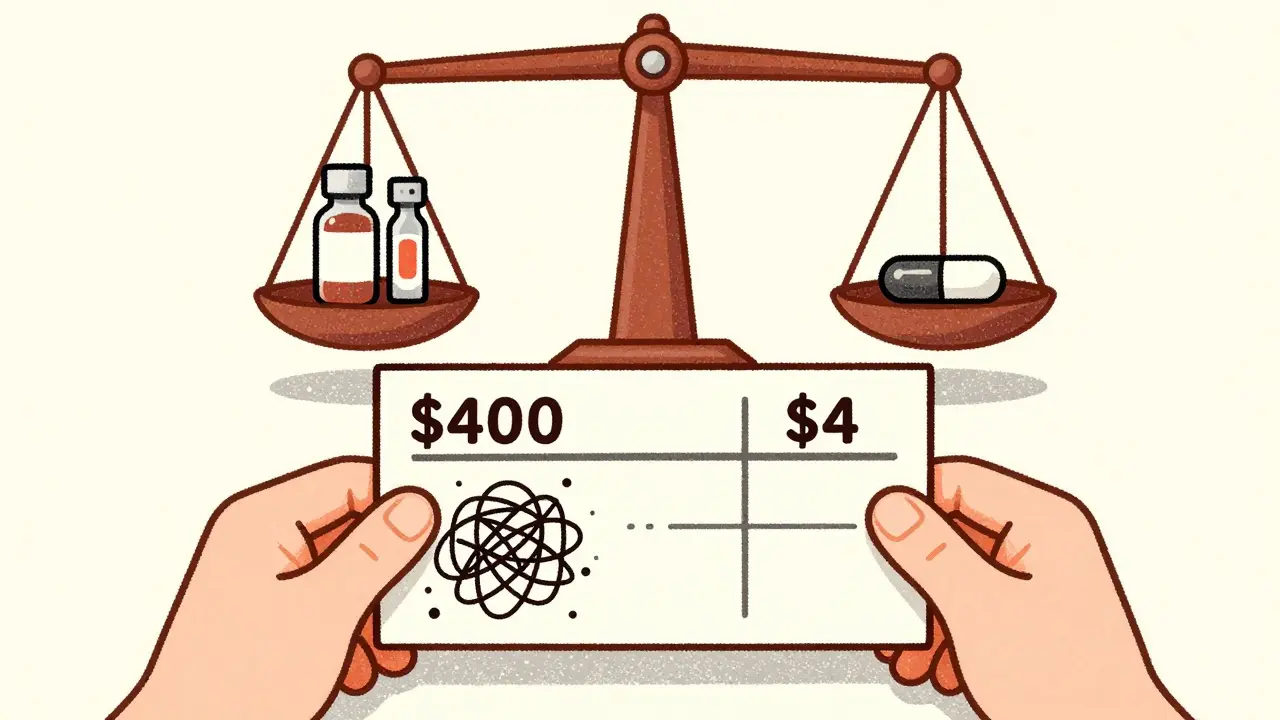
These court decisions aren’t abstract. They’re why your prescription costs $40 instead of $400. When a biologic patent gets narrowed by Amgen v. Sanofi, you get biosimilars sooner. When Allergan v. Teva shuts down patent evergreening, your cholesterol med drops in price. When Amarin v. Hikma holds generics accountable for labeling, it keeps competition fair - but also raises the legal cost for generics, which can slow down entry. The system is flawed, but it’s working. In 2024, 85% of U.S. prescriptions were filled with generics (FDA). That’s up from 78% in 2014. And when generics enter, prices fall 80-85% within a year (FTC 2023). That’s not magic. It’s law.
The Road Ahead
What’s next? The FDA is pushing a 2025 rule to require stricter proof that patents listed in the Orange Book actually relate to the drug. That could cut down on frivolous listings. Meanwhile, biosimilars are rising. By 2027, they’ll make up 31% of all generic patent challenges (Evaluate Pharma). And courts are getting better at distinguishing real innovation from legal padding. The challenge? Keeping the balance. Too strict on patents, and innovation slows. Too lenient, and patients pay more. The courts are walking that line - one case at a time.
What is the Hatch-Waxman Act and why does it matter for generic drugs?
The Hatch-Waxman Act of 1984 created a legal pathway for generic drug manufacturers to bring cheaper versions to market without repeating expensive clinical trials. It lets generics file an ANDA and challenge patents through Paragraph IV certification. In return, brand companies get extended patent terms to make up for FDA review time. This law is the foundation of modern generic competition - it’s why 85% of U.S. prescriptions are filled with generics today.
How do Paragraph IV certifications trigger patent lawsuits?
When a generic company files an ANDA and certifies that a brand’s patent is invalid or won’t be infringed (a Paragraph IV certification), it legally notifies the brand that they’re challenging the patent. The brand then has 45 days to sue. If they do, the FDA can’t approve the generic for 30 months - unless the court rules in the generic’s favor sooner. This 30-month stay is often used to delay competition, even if the patent is weak.
Why are biologic patents harder to challenge than small-molecule patents?
Biologics are complex proteins made from living cells, not chemically synthesized like small-molecule drugs. Their patents often cover broad functional claims - like “an antibody that binds to X.” Before Amgen v. Sanofi, companies got away with this. Now, courts demand detailed proof that the patent enables others to make all claimed versions. This makes biologic patents more vulnerable to challenge, but also harder to draft correctly - raising the bar for both brand and generic companies.
Can a generic drug be sued for infringement even if it’s chemically identical?
Yes. In Amarin v. Hikma, the court found that even though Hikma’s drug was chemically identical to Amarin’s, its labeling suggested off-label uses. That’s called induced infringement. The generic didn’t make a new drug - but its marketing materials encouraged doctors to use it in ways not approved by the FDA. That’s enough to trigger a lawsuit. It means generic companies must treat their labeling like legal documents - not just medical instructions.
What role does the Orange Book play in generic drug approval?
The Orange Book lists every patent associated with a brand-name drug. Generics must review this list and certify whether they’re challenging any listed patents. If a patent is listed incorrectly - say, for a packaging design instead of the active ingredient - the generic can ask the FDA to remove it. But many patents are listed deceptively to delay competition. Courts are now cracking down, and the FDA plans stricter rules in 2025 to prevent this kind of manipulation.


Lebogang kekana
This is why I hate how drug companies game the system. They don't even try to innovate anymore - they just file stupid patents on packaging or delivery methods and sit on them for a decade. I got my insulin last year after a 4-year wait. My cousin wasn't so lucky. This isn't capitalism. It's legal extortion.
And don't even get me started on the 180-day exclusivity loophole. It's a cartel disguised as competition. The first filer gets rich while the rest of us wait. Wake up, America.