

Walking into an eye clinic today feels more like visiting a tech hub than a doctor's office. If you've ever had a technician ask you to stare at a red light while a machine clicks and whirs around your eye, you've experienced the modern world of Ophthalmic Imaging. These tools are no longer just for specialized surgeons; they are the primary way doctors see what is actually happening inside your retina without having to perform surgery. But why do you need a 3D scan if you already had a photo taken? Why does one test require a dye injection while another doesn't? Understanding these tools helps you make sense of your diagnosis and know what to expect during your visit.
Quick Summary of Eye Imaging Tools
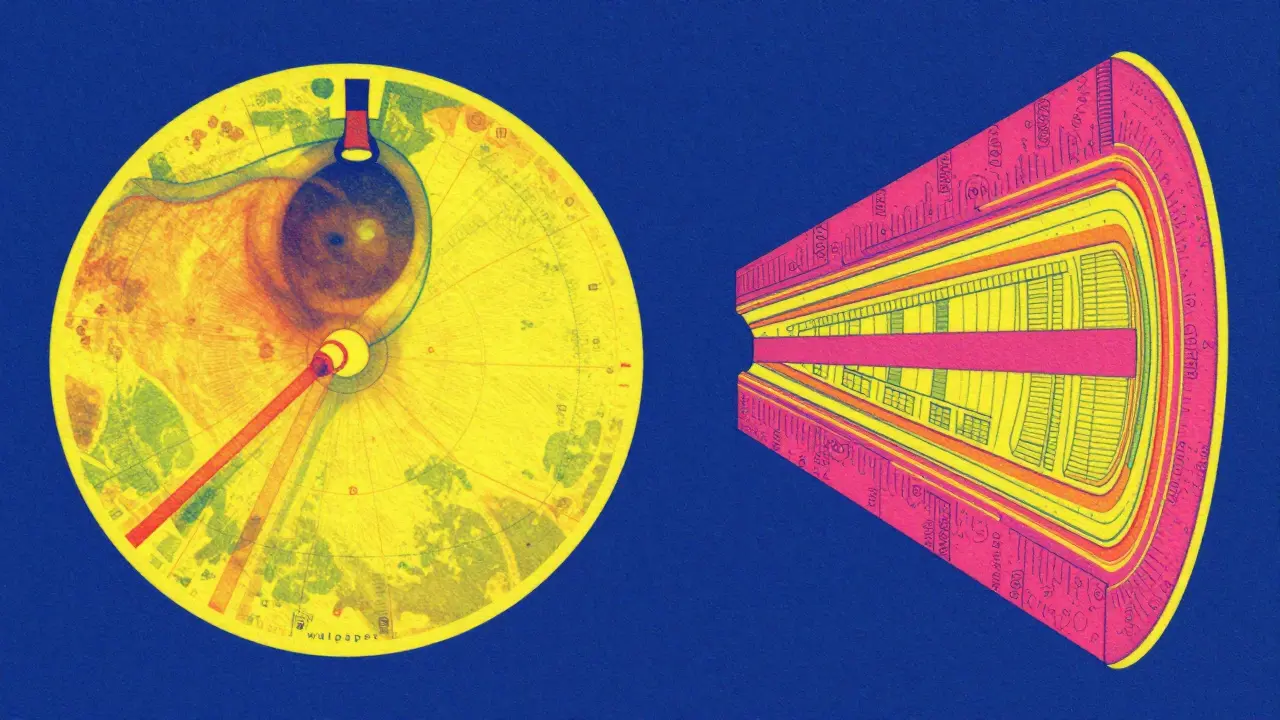
- Fundus Photography: A high-resolution 2D photo of the back of the eye (the "wallpaper").
- OCT: A non-invasive 3D cross-section scan (the "architectural blueprint").
- Fluorescein Angiography: An invasive dye-based test to check for leaks and blood flow.
- OCTA: A new, dye-free way to map blood vessels in 3D.
The Basics: Fundus Photography
Think of Fundus Photography is a specialized imaging technique that captures a two-dimensional photograph of the interior surface of the eye, specifically the retina, optic disc, and macula. It is essentially the "baseline" for any eye exam. If a doctor needs to track a lesion or a hemorrhage over six months, they use these photos to compare the current state to the previous one.
While a standard camera takes a photo of your face, a fundus camera (like the Zeiss FF 450+) uses a powerful flash and a specialized lens to look through your pupil and snap a picture of the posterior pole. It's fast and painless, but it only shows the surface. It can tell a doctor that there is a bleed or a yellow deposit (exudate), but it can't tell them how deep that bleed goes or if it's pushing the retinal layers apart.
Optical Coherence Tomography: The Eye's MRI
When the doctor needs to see inside the tissue, they use Optical Coherence Tomography (or OCT) a non-invasive imaging technology that uses light waves to create high-resolution cross-sectional images of the retina and choroid. If a fundus photo is like looking at a map of a city, an OCT is like looking at a slice of a building to see the plumbing and wiring.
Most clinics now use Spectral-Domain OCT (SD-OCT), which provides incredibly sharp detail-down to 5-7 micrometers. This allows doctors to spot things like macular holes or tiny pockets of fluid (edema) that are invisible to the naked eye. There is also a newer version called Swept-Source OCT (SS-OCT). This version is like a high-speed camera; it takes hundreds of thousands of scans per second, allowing it to penetrate deeper into the choroid (the blood-rich layer under the retina).
For someone with a condition like Coats disease, OCT is a game-changer. It can reveal hyperreflective dots-which are actually macrophages (immune cells)-and cholesterol crystals that would never show up on a standard photo.
Fluorescein Angiography: Checking the Plumbing
Sometimes, knowing the structure isn't enough; the doctor needs to see how the blood is actually moving. This is where Fluorescein Angiography (FA) an invasive diagnostic procedure where a fluorescent dye is injected into the bloodstream to visualize retinal circulation and leakage comes in. This technique has been the gold standard since the 1960s for detecting "leaky" vessels.
Here is how it works: A bright yellow-green dye is injected into your arm. As the dye travels to your eye, a camera takes a series of rapid-fire photos. If the blood vessels are damaged, the dye leaks out into the surrounding tissue, lighting up like a neon sign. This is incredibly useful for diagnosing proliferative diabetic retinopathy, where the eye grows abnormal, fragile new vessels that leak fluid and blood.
The downside? It's invasive. It takes 10 to 30 minutes, requires an IV, and carries a small risk of allergic reactions. Because it's subjective (a doctor has to "interpret" the glow), it's not as precise as a digital scan.
The New Frontier: OCT Angiography (OCTA)
Since around 2014, a new tool called OCT Angiography (or OCTA) a non-invasive imaging method that maps blood flow in the retina and choroid by detecting the movement of red blood cells has started replacing the need for dye in many cases. Instead of using a chemical dye, OCTA uses the movement of your own red blood cells as the "contrast agent."
Imagine taking a video of a crowd and then subtracting everything that isn't moving. What you're left with is just the flow of traffic. That is essentially how OCTA works. It allows doctors to see the superficial, middle, and deep capillary plexuses of the fovea in a matter of seconds.
For patients with Punctate Inner Choroidopathy (PIC), OCTA can find areas of non-perfusion-basically "dead zones" where blood isn't flowing-that were previously invisible even with dye-based angiography. It's faster, safer, and provides 3D data that FA simply cannot.
| Feature | Fundus Photo | OCT / OCTA | Fluorescein Angiography |
|---|---|---|---|
| Invasiveness | Non-invasive | Non-invasive | Invasive (Dye Injection) |
| Dimension | 2D (Surface) | 3D (Cross-section/Volume) | 2D (Dynamic Flow) |
| Key Strength | Baseline Documentation | Anatomy & Layering | Sensitivity to Leaks |
| Time Required | Seconds | Seconds to Minutes | 10-30 Minutes |
| Patient Risk | None | None | Allergic Reaction Risk |
Which Tool Is Best? The Multimodal Approach
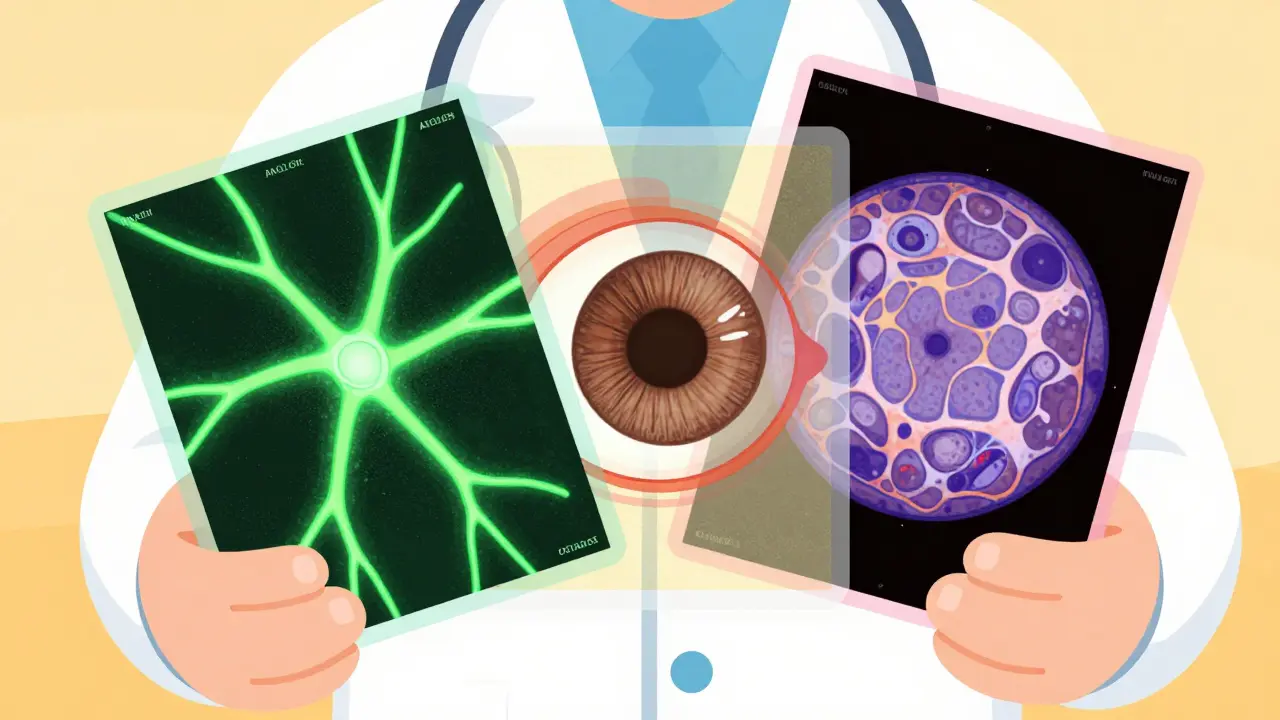
You might wonder why your doctor doesn't just use OCTA and call it a day. The truth is, no single tool is perfect. Experts use a "multimodal" approach, meaning they combine different images to get the full story. For example, while OCTA is great for seeing the shape of a vessel, it cannot see leakage. If a vessel is leaking fluid into the retina (common in diabetic macular edema), a traditional Fluorescein Angiography is still more sensitive and reliable.
Similarly, for a macular hole, the structural detail of a standard SD-OCT is superior to any vascular map. In cases of severe retinal vein occlusions, the dye-based FA helps doctors see exactly where the blockage is occurring in a way that the non-invasive scans sometimes miss.
One practical challenge with the newer scans is movement. Because OCT and OCTA rely on micron-level precision, if you blink or shift your gaze, the image can be blurred by "motion artifacts." This makes these tests harder for children or patients with advanced dementia who struggle to keep their eyes fixed on the target.
Does the dye in angiography cause permanent changes to my vision?
No, the fluorescein dye does not change your vision. However, it will temporarily turn your skin a yellowish tint and make your urine glow bright yellow for 24 to 48 hours as your body flushes the dye out of your system.
Is OCT the same as a comprehensive eye exam?
No. A comprehensive exam includes checking your vision (acuity), measuring eye pressure, and a physical examination of the eye. OCT is a diagnostic imaging tool used during or after an exam to look closer at specific issues the doctor suspects are present.
Can OCTA completely replace the need for dye-based angiography?
Not yet. While OCTA is excellent for mapping blood vessels without dye, it cannot detect "leakage" (where fluid escapes the vessel). For conditions like diabetic macular edema, doctors still need the dye to see how much fluid is leaking into the retina.
How often do I need these scans if I have a chronic condition?
This depends on your specific disease. For stable conditions, a scan might happen once a year. For active conditions like wet AMD or severe diabetic retinopathy, you might have OCT scans every 4-8 weeks to monitor the effectiveness of injections.
What happens if I can't keep my eye still during an OCT scan?
If you struggle with fixation, the image may have "artifacts" (gaps or distortions). Technicians may try different fixation targets or, in some cases, a doctor might rely more on fluorescein angiography, which is less dependent on millisecond-perfect stillness.
Next Steps and Troubleshooting
If you are scheduled for imaging, here is how to handle different scenarios:
- For those with anxiety about needles: If you are scheduled for Fluorescein Angiography, tell your technician. They can use numbing creams or provide tips to make the IV process easier.
- For those with dry eyes: Use preservative-free artificial tears before an OCT scan. A dry cornea can sometimes cause "noise" or blurriness in the image.
- For those with large pupils: Your doctor will likely use dilating drops. This is essential for fundus photography and angiography to ensure the camera has a clear window into the back of the eye.
- Reviewing your results: Don't be alarmed by the complex colors (reds, yellows, and greens) on an OCT map. These are "heat maps" showing thickness; your doctor will explain whether the thickness is normal or indicates swelling.


