
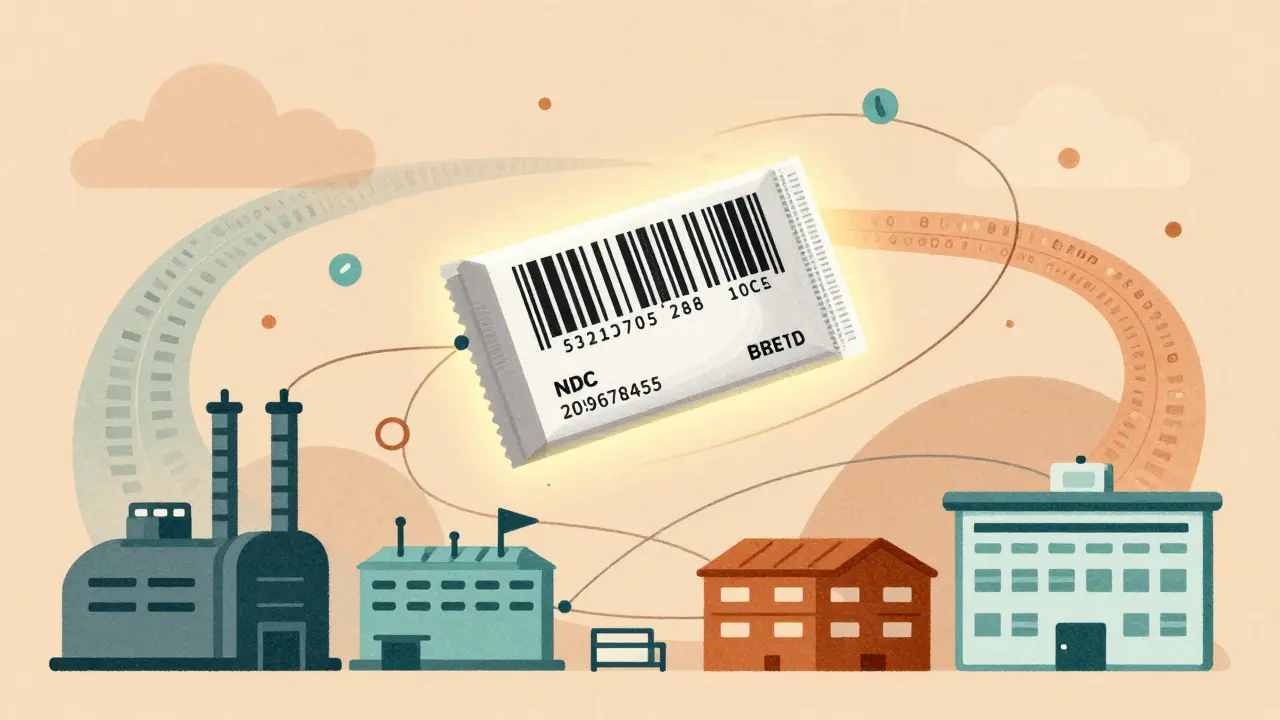
Every year, over 5.8 billion prescription drug packages move through the U.S. supply chain-from factories to pharmacies, to your hands. But how do we know those pills, injections, or patches are real? Not fake. Not contaminated. Not stolen? The answer isn’t just about vigilance. It’s a complex, technology-driven system built over a decade to stop counterfeit drugs before they reach patients.
What’s at Stake: The Real Danger of Fake Medicines
Counterfeit drugs aren’t just about fake branding. They’re about life and death. A fake antibiotic might contain no active ingredient, letting an infection spread. A counterfeit cancer drug could have the wrong dose-or toxic chemicals. The FDA seized over 1,100 fake drug packages in 2014. By 2022, that number dropped to 412. That 63% decline didn’t happen by accident. It’s the result of a federal law called the Drug Supply Chain Security Act (DSCSA), passed in 2013 and fully enforced by 2023.This isn’t just a U.S. problem. Around the world, an estimated 1 in 10 medicines are fake, according to the WHO. But the U.S. system is one of the most advanced. It doesn’t rely on luck or inspections. It uses technology to track every single package from the moment it’s made.
The DSCSA Framework: How Each Package Gets a Digital Fingerprint
At the heart of U.S. drug security is something called serialization. Every prescription drug package-whether it’s a bottle of 30 pills or a single vial of insulin-now carries a unique 2D barcode. This isn’t just a logo or a lot number. It’s a digital fingerprint made up of four key pieces of data:- National Drug Code (NDC): Identifies the drug, strength, and manufacturer
- Serial number: A unique code for that exact package
- Lot number: Tracks which batch it came from
- Expiration date: When it’s no longer safe to use
That’s over 1.2 million unique identifiers created every single day. Each one is scanned and recorded as the product moves from manufacturer to wholesaler to pharmacy. If a package turns up suspicious-say, it’s missing a barcode or the serial number doesn’t match the manufacturer’s records-the system flags it instantly.
How the System Talks to Itself: EPCIS and Interoperability
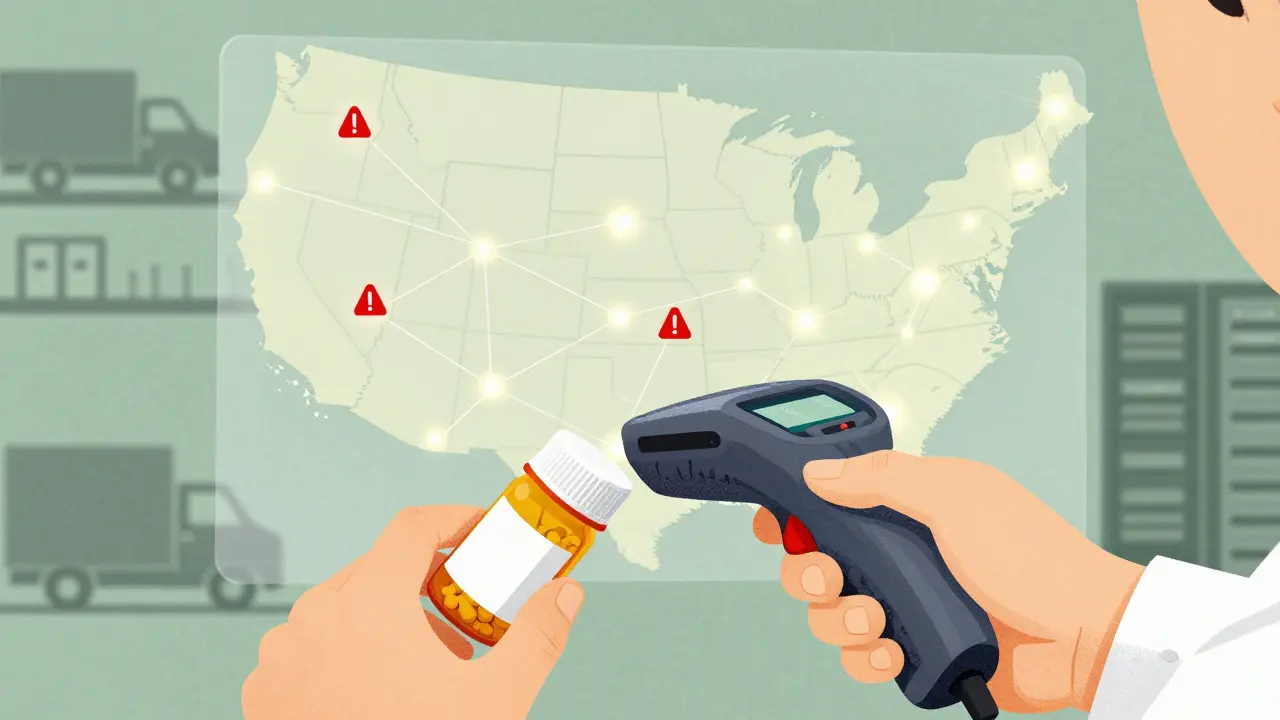
All these scans don’t mean anything if the data can’t be shared. That’s where EPCIS comes in-Electronic Product Code Information Services. It’s a global standard created by GS1, and it’s the language every player in the supply chain must use to exchange data. Think of it like a shared cloud ledger that updates in real time.When a pharmacy receives a shipment, it doesn’t just check the boxes. It scans each package and sends the data to a secure network. If the serial number doesn’t match what the manufacturer says was shipped, the system alerts the pharmacy. That’s how fake or stolen drugs get caught before they’re sold.
By November 2027, every single transaction must be electronic. No more paper forms. No more faxed invoices. This full interoperability is the final piece of the puzzle. Right now, 92% of manufacturers, 87% of wholesalers, and 76% of pharmacies are compliant. But the last 24%-mostly small, independent pharmacies-are still struggling with the cost and complexity.
Who’s in the Chain? Authorized Trading Partners and Verification
You can’t just buy and sell drugs from anyone. The DSCSA requires every company in the chain to be an Authorized Trading Partner (ATP). That means the FDA has verified their identity and legitimacy. Every time a wholesaler ships to a pharmacy, the pharmacy must check that the sender is on the approved list.The FDA’s ATP Verification Router Service handles over 50,000 of these checks daily-with a 99.8% success rate. If someone tries to sell drugs from an unapproved supplier, the system blocks it. In one case, a small pharmacy in Ohio blocked three fake offers in a single month because the supplier wasn’t in the ATP database.
But here’s the catch: verification isn’t automatic. Companies have to set it up. According to FDA audits in 2022, only 47% of wholesale distributors were consistently doing these checks. That’s a gap. And it’s why some experts argue the system still has holes.
Real-World Impact: When the System Worked-and When It Didn’t
In 2022, during the infant formula crisis, the DSCSA system saved lives. When a batch was suspected of contamination, the FDA traced it back to the exact production line in under 72 hours. Before this system, that process took two weeks. That speed is what makes it powerful.But it’s not perfect. A 2023 cyberattack on Change Healthcare disrupted verification systems for 72 hours, affecting 35% of U.S. pharmacies. That’s a major vulnerability. If hackers can break into the network, they could potentially flood it with fake data.
Smaller pharmacies are feeling the strain. One owner in Oregon told the National Community Pharmacists Association that DSCSA compliance costs him $18,500 a year-3.2% of his net profit. He’s not alone. Sixty-three percent of independent pharmacies with fewer than 10 employees say they struggled to meet the 2023 electronic data deadlines.
How It Compares: U.S. vs. Europe vs. the Rest of the World
The U.S. isn’t the only one trying to fix this. The European Union uses the Falsified Medicines Directive (FMD), which also requires serialization-but with a key difference. In Europe, every package must be “decommissioned” at the pharmacy. That means once you scan it to dispense the drug, the system marks it as used. If someone tries to resell it, the system knows.Meanwhile, China forced serialization on all manufacturers overnight in 2019. The result? 37% of companies had supply chain breakdowns. The U.S. took 14 years to roll this out. That slower pace gave companies time to adapt.
The problem? No global standard. A drug made in Germany and shipped to the U.S. must meet both EU and U.S. rules. That means double barcodes, double systems, double costs. Global pharma companies spend 22% more on compliance than U.S.-only firms.
What’s Next? AI, Blockchain, and the Future of Drug Security
The system isn’t static. Companies are already testing new tools:- AI anomaly detection: 27% of wholesalers now use AI to spot odd patterns-like a package being scanned in the wrong state or at an odd time.
- Blockchain trials: 34% of top pharma companies are testing blockchain to create tamper-proof logs of every transaction.
- IoT sensors: 19% of cold-chain shipments now track temperature and shock in real time. If insulin gets too warm, the system alerts the pharmacy before it’s dispensed.
By 2030, experts predict the system will evolve into a predictive tool. Instead of just reacting to fake drugs, it’ll predict where they’re likely to appear-and stop them before they’re even shipped.
What You Can Do: Stay Informed, Stay Alert
As a patient, you won’t see the barcode scans or the digital logs. But you can still protect yourself:- Check your pills. Are they the right color, shape, or size? If something looks off, ask your pharmacist.
- Buy from licensed pharmacies. Avoid websites that sell drugs without a prescription.
- Ask your pharmacist if they use DSCSA-compliant systems. Most do-but not all.
The system works best when everyone plays their part. The technology is there. The rules are clear. The data is flowing. The real challenge now is making sure no one gets left behind-especially the small pharmacies and clinics that serve the most vulnerable patients.
How does serialization stop counterfeit drugs?
Serialization gives each drug package a unique digital fingerprint-like a serial number on a smartphone. Every time the package moves through the supply chain, its data is scanned and recorded. If a fake package enters the system, its serial number won’t match the manufacturer’s records. Pharmacies and distributors can instantly flag and isolate it before it reaches a patient.
Is the DSCSA system foolproof?
No system is completely foolproof. While DSCSA has reduced counterfeit incidents by 63% since 2015, gaps remain. Some small pharmacies still struggle with compliance. Cyberattacks can disrupt verification systems. And international supply chains create vulnerabilities where U.S. rules don’t apply. The system is strong-but it needs constant updates and enforcement.
Why do some pharmacies complain about DSCSA costs?
Implementing serialization and electronic data exchange requires new software, barcode scanners, staff training, and IT support. For a small independent pharmacy, these costs can reach $18,000-$25,000 per year. That’s a big hit for businesses with thin profit margins. Many rely on grants or shared platforms to manage the burden.
Can I verify my own prescription’s authenticity?
You can’t scan the barcode yourself yet-those systems aren’t public. But you can ask your pharmacist if they use DSCSA-compliant verification. If they do, your medication has been checked against the manufacturer’s database. Also, look for changes in pill appearance. If your generic medication suddenly looks different, ask why.
What happens if a fake drug gets past the system?
The system is designed for rapid response. If a suspect product is identified, distributors must investigate within 24 hours. They verify the serial number, test the product, and quarantine it. The FDA then issues a recall. In 2022, over 12,000 suspect products were flagged and stopped before reaching patients. The system’s speed is its greatest strength.
Will this system work globally?
Not yet. The U.S. (DSCSA), EU (FMD), and other countries have different rules for serialization, data formats, and verification. A drug moving from Japan to Brazil to the U.S. may need three different barcodes. Global harmonization is underway through the ICH, but full alignment won’t happen until 2026 or later. Until then, multinational companies face higher costs and complexity.


Jarrod Flesch
This is actually one of the most reassuring things I've read all year. I never thought about how many scans happen between the factory and my medicine cabinet. Knowing there's a digital trail for every pill? That's peace of mind. 🙌