
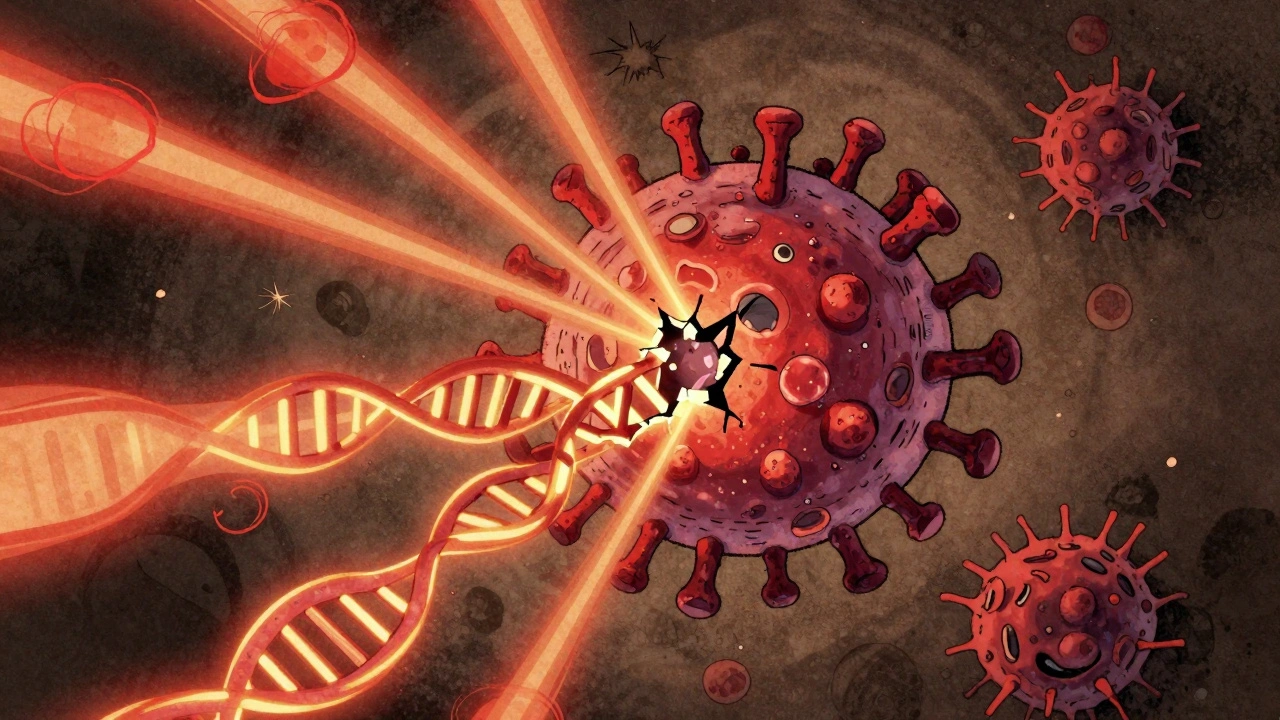
When you hear radiation therapy, you might think of scary images from old movies-glowing machines, glowing patients, or side effects that feel worse than the disease. But modern radiation therapy is nothing like that. It’s precise, powerful, and deeply scientific. At its core, it’s a battle fought inside the DNA of cancer cells. And the way it wins? By breaking the very code that lets cancer grow.
How Radiation Breaks DNA
Radiation therapy uses high-energy particles or waves-usually X-rays or protons-to target tumors. These aren’t just energy beams. They’re ionizing radiation, meaning they have enough power to knock electrons out of atoms. That tiny act triggers a chain reaction inside cells. When radiation hits water molecules in the cell (and there’s a lot of water in your body), it creates reactive oxygen species, or ROS. These are unstable, aggressive molecules that attack everything nearby: proteins, lipids, and especially DNA. But the real killer? Double-strand breaks. That’s when both sides of the DNA ladder snap apart at the same spot. A single cell can get dozens of these breaks in seconds. Unlike a cut on your skin, which heals cleanly, broken DNA in cancer cells doesn’t just patch itself up. The cell tries to fix it, but the damage is too chaotic. And that’s when things fall apart.The Cell’s Last Stand: DNA Repair vs. Death
Every cell has repair tools. When radiation shreds DNA, two main systems jump in: non-homologous end joining (NHEJ) and homologous recombination (HR). NHEJ is like duct tape-it sticks broken ends back together fast, but often messes up the sequence. HR is more like a master repair technician-it uses a clean copy of DNA as a template to fix the break perfectly. Here’s the twist: cancer cells that rely on HR to fix their DNA? They die quietly. They don’t scream for help. They just stop dividing during cell division and vanish without a trace. But cells that use NHEJ-or can’t repair at all-don’t just die. They leak signals. They release molecules that look like infection warnings to the immune system. It’s as if the cancer cell is shouting, “Help! Something’s wrong here!” This discovery changed everything. For years, doctors thought radiation only worked by killing cells directly. Now we know it can also turn cancer into a target for the immune system. That’s why combining radiation with immunotherapy is one of the biggest advances in cancer care today.Why Some Tumors Resist Radiation
Not all cancers respond the same. About 30-40% of tumors develop resistance. Why? Because cancer is sneaky. Some tumors ramp up their DNA repair systems. Others slow down their cell cycle so they’re less vulnerable. Some even create low-oxygen zones inside the tumor-called hypoxia-which makes radiation 2-3 times less effective. Oxygen helps radiation damage DNA. No oxygen? Less damage. Then there’s the role of specific genes. If a tumor has a mutation in BRCA1 or BRCA2, it can’t use HR properly. That sounds bad-but it’s actually an advantage in treatment. These tumors are more likely to use the messy NHEJ repair. That means they’re more likely to trigger immune alerts after radiation. That’s why patients with BRCA mutations often respond better to radiation, especially when paired with drugs like PARP inhibitors. A 2023 study tracked irradiated cancer cells for a full week. They found that BRCA2-deficient cells didn’t die during mitosis like others. Instead, they lingered, leaked signals, and attracted immune cells. That’s a game-changer. It means we can now pick which tumors will respond best-and tailor the treatment.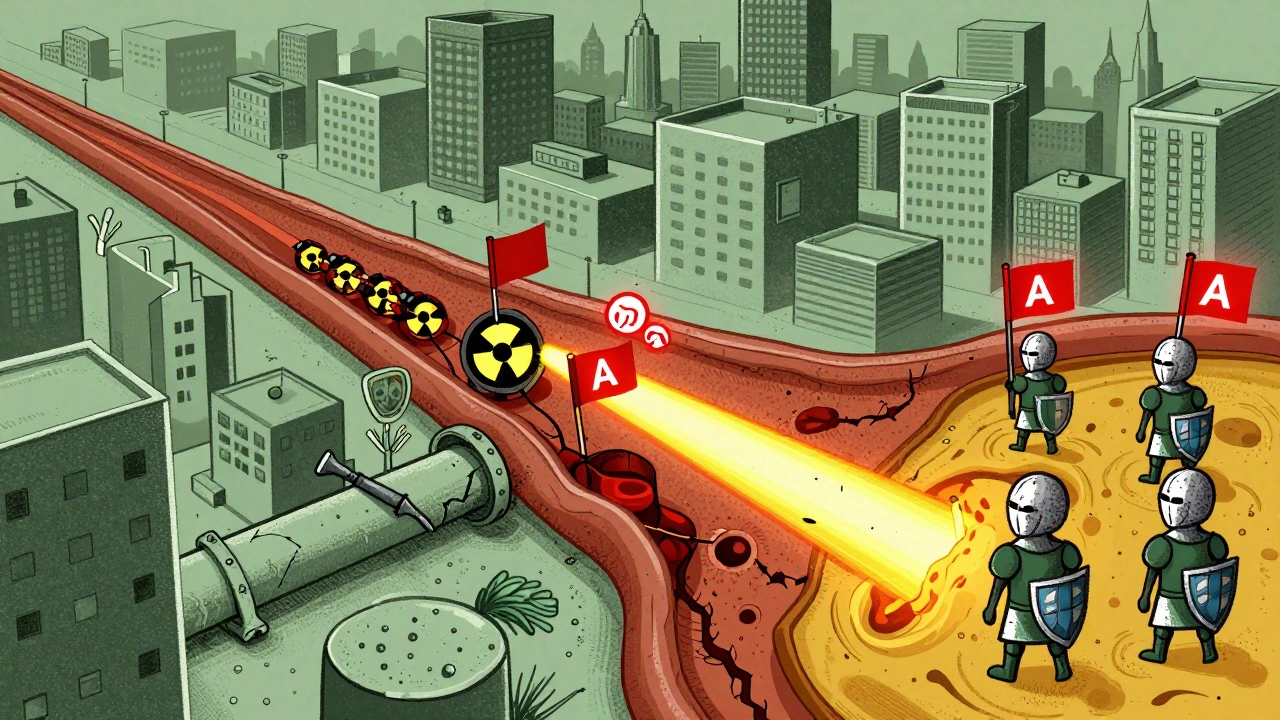
The Role of the Tumor Environment
Radiation doesn’t just hit cancer cells. It hits the whole neighborhood. The tumor microenvironment-made up of blood vessels, immune cells, and fibroblasts-plays a huge role. Radiation can damage the blood vessels feeding the tumor. That cuts off oxygen and nutrients. Days after treatment, cancer cells starve and die from lack of support, not just direct radiation damage. This is especially true with high-dose treatments like SBRT (stereotactic body radiation therapy). A single high-dose session can trigger a wave of cell death in the tumor’s blood supply through the ceramide pathway. Ceramide is a signaling molecule that tells cells to die. Radiation turns it on like a switch. And here’s another surprise: radiation can make cancer cells more visible to the immune system. It changes how they present proteins on their surface. It’s like painting a target on them. Studies show irradiated cells display more unique antigens, making it easier for T-cells to find and destroy them.Modern Tools, Smarter Delivery
Old radiation therapy was like firing a shotgun at a target. Now, it’s more like a sniper rifle. Tools like IMRT (intensity-modulated radiation therapy) and SBRT shape the radiation beam to match the tumor’s exact shape. Modern linear accelerators deliver doses accurate to less than a millimeter. That means less damage to your lungs, heart, or spinal cord. Even more exciting? FLASH radiotherapy. It delivers the entire dose in less than a second-faster than a camera shutter. In animal studies, it kills tumors just as well but spares healthy tissue far better. Human trials began in 2020, and early results show promise for reducing side effects like skin burns or fatigue. Artificial intelligence is now helping plan treatments in under 10 minutes. What used to take hours of manual work is now automated. AI can predict how a tumor will respond, adjust for breathing motion, and even flag hidden areas the radiation might miss.
What Comes Next?
The future of radiation therapy isn’t just about stronger beams. It’s about smarter combinations. Pairing radiation with immunotherapy drugs like pembrolizumab has already boosted response rates in lung cancer from 22% to 36%. Adding PARP inhibitors for BRCA-mutated cancers is showing similar promise in breast and ovarian tumors. We’re also learning when to give radiation. High-dose, low-fraction treatments (like SBRT) work differently than the old 30-session model. They trigger different repair pathways and stronger immune signals. That means fewer visits, better results. The biggest shift? We’re no longer just trying to kill cancer cells. We’re trying to wake up the body’s own defenses. Radiation isn’t just a tool-it’s a signal. And when used right, it turns the immune system into a permanent guard against recurrence.Final Thoughts
Radiation therapy isn’t magic. It’s biology. It exploits the weaknesses of cancer cells-their fast growth, their broken repair systems, their dependence on oxygen. And now, thanks to new science, we’re learning how to turn those weaknesses into advantages. It’s not about blasting the tumor until it’s gone. It’s about guiding the body to finish the job. That’s why, today, more than half of all cancer patients get radiation. Not because it’s the easiest option. But because, when used right, it’s one of the most powerful tools we have.Does radiation therapy make you radioactive?
No. External beam radiation therapy-what most people receive-does not make you radioactive. The radiation passes through your body and is gone the moment the machine turns off. You can safely be around other people, including children and pregnant women, right after treatment. This is different from internal radiation (brachytherapy), where a small radioactive source is placed inside the body. Even then, the risk to others is minimal and carefully managed.
How long does it take for radiation to kill cancer cells?
Radiation doesn’t kill cells instantly. It damages their DNA, and the cells die over days or weeks as they try to divide. Some cells die right away; others survive for a while before failing during cell division. That’s why treatment usually takes several weeks-it gives time for all the cancer cells to reach that critical point. Even after the last session, cancer cells continue to die for weeks.
Why do side effects happen if radiation targets only the tumor?
Even with the most precise technology, some healthy tissue near the tumor gets exposed. That’s why side effects like skin redness, fatigue, or sore throat occur-they’re signs of minor damage to nearby cells. Modern techniques minimize this, but they can’t eliminate it entirely. The body repairs most of this damage over time. Side effects are usually temporary and manageable with supportive care.
Can radiation therapy cure cancer on its own?
Yes, for many early-stage cancers-like prostate, cervical, head and neck, or some lung cancers-radiation alone can be curative. It’s often as effective as surgery, with fewer risks. For advanced cancers, radiation is usually combined with chemotherapy, immunotherapy, or surgery to improve outcomes. The goal isn’t always cure-it’s control, comfort, and longer life.
Is radiation therapy safer now than it was 20 years ago?
Much safer. Twenty years ago, radiation beams were broader and less precise. Today’s machines use 3D imaging, real-time tracking, and AI to shape beams to the tumor’s exact size and shape. Doses to healthy organs have dropped by 30-50% in many cases. Side effects like secondary cancers or organ damage are far rarer. The technology isn’t just better-it’s smarter.
What happens if radiation doesn’t work?
If the tumor doesn’t respond, doctors look at why. Was it too hypoxic? Did it have strong DNA repair genes? Was the dose high enough? Sometimes, a different type of radiation (like proton therapy) or a combination with immunotherapy or targeted drugs can help. In some cases, surgery or chemotherapy becomes the next step. Radiation isn’t a one-shot deal-it’s part of a larger strategy.


Ollie Newland
Radiation-induced double-strand breaks are fascinating from a biophysics standpoint. The ROS cascade is messy, but the real elegance is in how NHEJ introduces error-prone repairs that trigger immunogenic cell death. It’s not just cytotoxicity-it’s a deliberate alarm system. The ceramide pathway activation post-SBRT is underappreciated in clinical literature.