
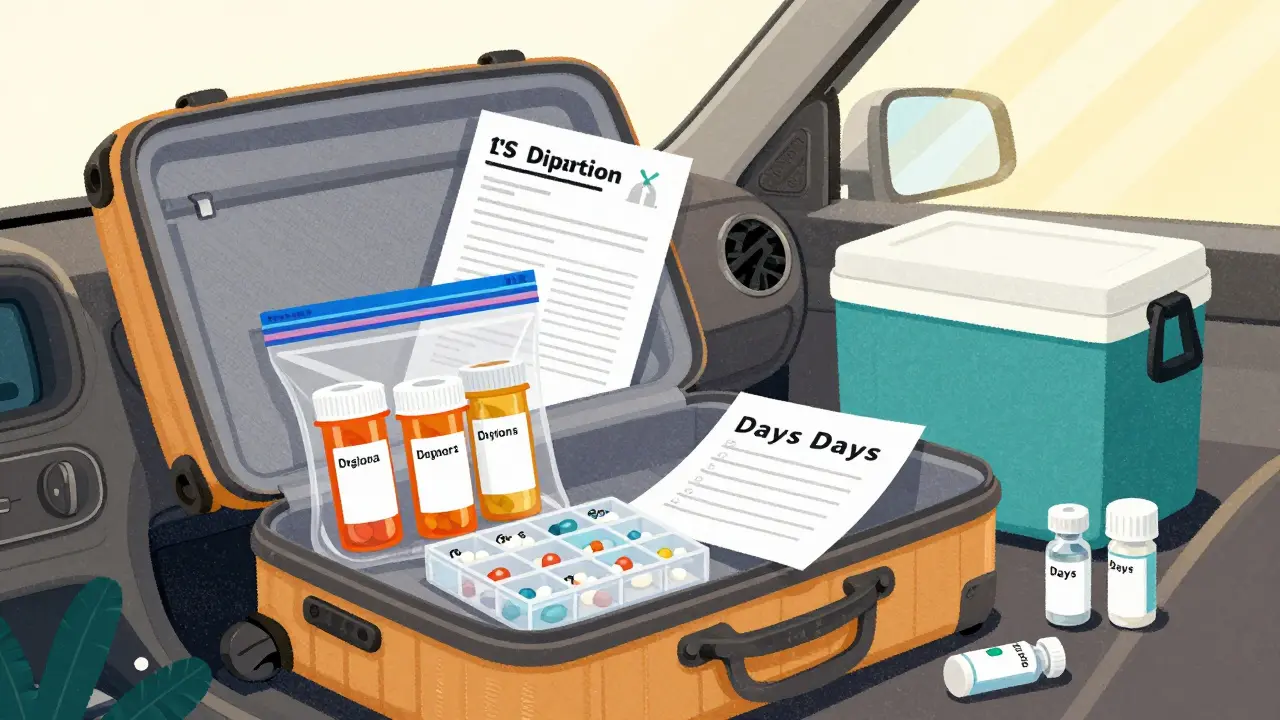
Running out of medication halfway through a road trip or stuck on a cruise ship with no access to your pills is more common than you think. It’s not just about forgetting - it’s about packaging, laws, and timing. Whether you’re driving across state lines or sailing through international waters, your meds need to be packed right - or you could face delays, confiscation, or worse. Here’s how to get it done without stress.
Start 30 Days Before You Leave
Don’t wait until the night before. Thirty days out, schedule a quick call with your doctor. Ask them to confirm: Are all your medications allowed in every country or state you’ll visit? Some drugs that are legal in the U.S. are banned in places like Japan, the UAE, or even a few U.S. states. For example, ADHD medications like Adderall are controlled substances in many countries. If you’re taking anything with codeine, oxycodone, or stimulants, your doctor may need to provide a signed letter explaining why you need it. Some cruise lines, like Norwegian and Carnival, require this 30 days before sailing.Keep Everything in Original Containers
This isn’t optional. Every major travel authority - TSA, CDC, Royal Caribbean, Cruise Critic - says the same thing: Keep meds in their original pharmacy bottles. That means the label with your name, the drug name, dosage, and pharmacy info must be visible. Why? Because customs officers and ship medical staff can’t guess what’s in a random pill organizer. In 2023, over 68% of reported medication issues on cruises involved unlabeled pills. One Reddit user, u/TravelMedNurse, shared that 37% of passengers with unlabeled meds were denied entry at ports. Don’t be that person.Bring Extra - But Not Just a Little
Travel delays happen. According to OAG Aviation, 23% of international flights are delayed by more than 3 hours. Road trips can get stuck in traffic for days. Pack at least three extra days’ worth of each medication. For road trips, two extra days is the bare minimum. For cruises, stick with three. Why? Because if your ship docks in a country where your medication is restricted, you might be stuck onboard for 24-48 hours without access to your meds. If you’re on insulin, blood pressure pills, or antidepressants, even one missed dose can be dangerous. Extra supply isn’t luxury - it’s insurance.Use the Right Packing System
You don’t need fancy gadgets, but you do need structure. Here’s what works:- Original bottles - for all prescription meds. Keep them together in a clear quart-sized Ziploc bag.
- Pill minders - if you use them, tape them shut and label each compartment with your name, date, and time (e.g., "Morning: Metformin 500mg"). Unlabeled pill boxes are a red flag.
- Travel pill envelopes - small, labeled envelopes with your name, drug, dose, and frequency. These are accepted by TSA and cruise lines if properly marked.
- Color-coded Ziploc bags - use one bag per medication type (e.g., blue for heart meds, green for pain relief). This cuts down on confusion and errors. One cruise traveler reduced their dosing mistakes by 100% using this method.
Carry-On Only - No Checked Bags
Never check your meds. The FAA and TSA both require essential medications in carry-on luggage. Why? Because 0.02% of bags get lost - and that’s enough to ruin your trip. If your bag goes missing, you could be without insulin, asthma inhalers, or thyroid pills for days. Cruise lines like Royal Caribbean explicitly state: "All medications must be in your carry-on." Even if you’re driving, keep them with you in your purse, backpack, or glove compartment - not in the trunk. If you’re pulled over or have an accident, first responders need to know what you’re taking.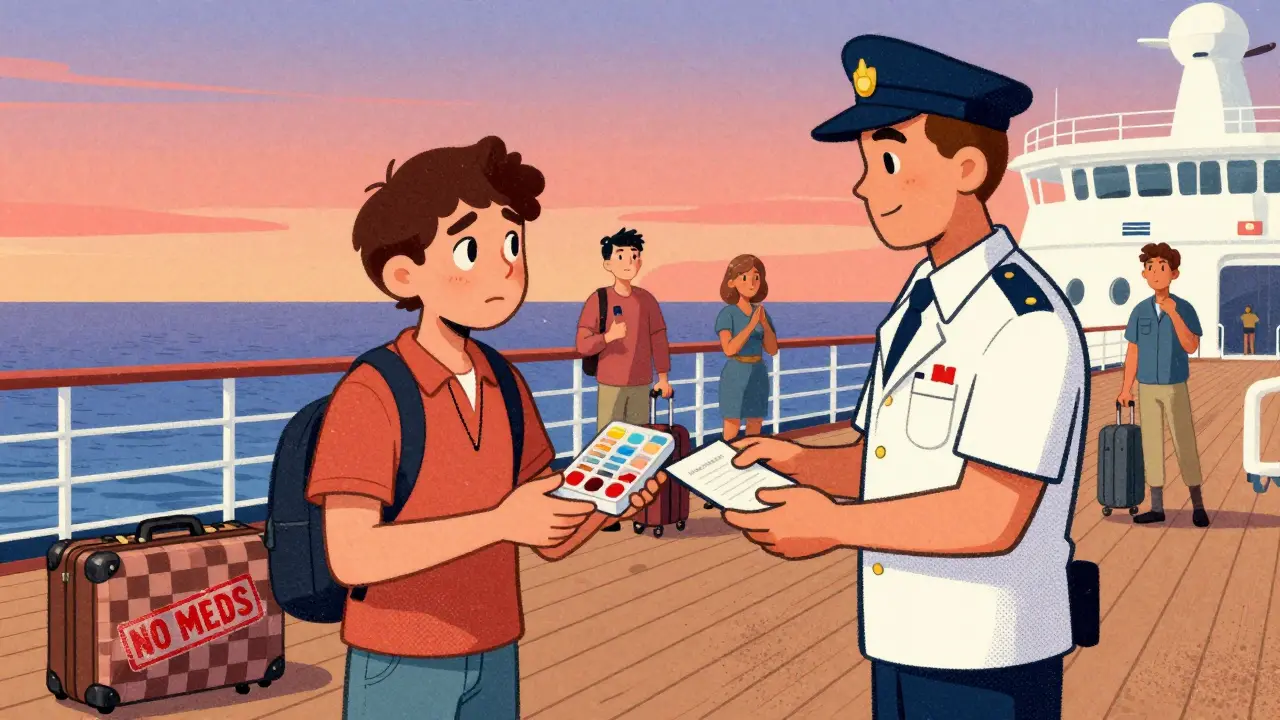
Bring Backup Documentation
A copy of your prescription or a letter from your doctor isn’t just helpful - it’s critical. The CDC recommends carrying a list with: drug name, generic name, dosage, frequency, and your doctor’s contact info. Print two copies. One goes in your wallet. The other goes in your carry-on with your meds. Some countries, especially in the Caribbean and Southeast Asia, require this paperwork to clear customs. Even if you’re not flying, state police in 13 U.S. states have confiscated medications for lack of documentation - especially medical marijuana, which is still illegal federally and in several states despite local laws.Watch Out for These High-Risk Meds
Some medications are more likely to cause problems:- Stimulants (Adderall, Ritalin): Banned in Japan, Singapore, UAE. Requires doctor’s letter.
- Opioids (codeine, oxycodone): Restricted in many countries. Cruise lines require pre-approval.
- Insulin: Must be in original packaging. Some airlines require a doctor’s note even though TSA allows it.
- Antidepressants and anti-anxiety meds: Some countries classify these as controlled substances. Check destination rules.
- Medical marijuana: Illegal on federal land, in most U.S. airports, and on cruise ships. Even if legal in your state, don’t bring it.
Temperature-Sensitive Meds? Protect Them
If you’re on insulin, biologics, or certain antibiotics, heat and cold can ruin them. The FDA says 41% of biologic meds need temperature control. Use a small insulated cooler with a cold pack. Don’t freeze insulin - just keep it cool. Some pharmacies now offer UV-protective travel cases that maintain safe temps for up to 72 hours. CVS and Walgreens offer free travel packaging for these meds - ask when you refill.Digital Backup Is a Must
Take a photo of every prescription label and save it in your phone’s Notes app. Create a simple text file with: drug name, dose, time taken, and doctor’s number. Upload it to Google Drive or iCloud so you can access it from any device. The CDC’s 2024 Traveler’s Health Update now includes a QR code checklist that links to destination-specific rules. Most U.S. travel clinics use it - you should too.
What to Do If You’re Denied or Confiscated
If customs or ship staff take your meds:- Stay calm. Don’t argue.
- Ask for a written explanation.
- Call your doctor - they may be able to fax a new prescription to a local pharmacy.
- If you’re on a cruise, contact the ship’s medical center. They can sometimes help you get a replacement if your condition is verified.
Final Checklist Before You Leave
- [ ] All meds in original labeled bottles- [ ] 3+ extra days’ supply
- [ ] Doctor’s letter for controlled substances
- [ ] Printed copy of prescription list
- [ ] Digital backup on phone and cloud
- [ ] Meds in carry-on - not checked bag
- [ ] Temperature-sensitive meds in insulated case
- [ ] No marijuana or unapproved substances
- [ ] Checked destination country’s rules via CDC or Smartraveller
What Happens If You Skip This?
In 2023, 214 cruise passengers had medication delays because they didn’t follow basic rules. One man missed three days of his cruise because his blood thinner was confiscated at a port. A woman with diabetes had to be airlifted after her insulin froze in a checked bag. Road trippers have been fined or detained for carrying unmarked pills. It’s not paranoia - it’s policy. The system is designed to protect you, not punish you. Follow the rules, and your trip stays smooth.What’s Changing in 2025?
Cruise lines are rolling out digital medication check-ins. Royal Caribbean now requires you to submit your med list 72 hours before sailing via their app. Carnival is testing fingerprint scanners on ship medical units to prevent theft - a real issue, with 1.2% of meds going missing on board. The global travel health market is growing fast, and pharmacies are responding with better travel packaging. By 2027, experts predict 65% fewer medication-related disruptions thanks to better global coordination. But until then - you’re still the best line of defense.Can I put my medications in a pill organizer for a cruise?
You can use a pill organizer, but only if it’s labeled with your full name, the medication name, dosage, and time of day. Tape it shut and keep the original bottles in your carry-on as backup. Unlabeled organizers are often confiscated.
Do I need a doctor’s note for my prescriptions on a cruise?
Yes, if you’re taking controlled substances like opioids, stimulants, or certain psychiatric meds. Most cruise lines require a signed letter from your doctor listing the medication, dosage, and reason for use. Even if not required, it’s smart to carry one.
Can I bring my medications on a plane in my carry-on?
Yes. TSA allows unlimited prescription medications in carry-on luggage. They don’t need to be in original containers, but it’s strongly recommended. Always keep them accessible - never in checked bags.
What if my medication is banned in a country I’m visiting?
Don’t bring it. Contact your doctor before you travel to find an alternative that’s legal in your destination. Some countries allow substitutions - others don’t. It’s safer to switch meds ahead of time than risk being denied entry or fined.
Should I bring over-the-counter meds too?
Absolutely. Pack basics like pain relievers, antidiarrheal, antihistamines, and motion sickness pills. Some countries restrict common OTC drugs like pseudoephedrine. Check the destination’s rules - but always keep them in original packaging.
Can I refill my prescriptions while traveling?
It’s possible, but not guaranteed. U.S. pharmacies can’t refill prescriptions from foreign doctors. If you’re on a cruise, ship medical staff may provide a short-term replacement, but it’s not a long-term solution. Always pack extra - don’t count on refills.
Is it okay to mix different meds in one bag?
Only if each bottle is clearly labeled. Mixing unlabeled pills in one bag is a red flag for security and customs. Use separate Ziploc bags by category (e.g., heart meds, diabetes, pain) and label each bag with your name.
What should I do if I lose my meds while traveling?
Call your doctor immediately. If you’re on a cruise, go to the ship’s medical center - they can often provide emergency doses. For road trips, find the nearest pharmacy and explain your situation. Bring your digital backup and doctor’s note to help them verify your prescription.
If you’re planning a trip this year, don’t let meds become your biggest worry. Plan ahead, pack smart, and you’ll have one less thing to stress about - whether you’re on the open road or the open sea.


Christina Bischof
I once forgot my anxiety meds on a road trip and ended up crying in a Walmart parking lot. Never again. Now I put everything in a Ziploc with a sticky note that says "DO NOT LOSE". Life hack.