

Metformin Side Effect Reduction Calculator
How Extended-Release Might Help You
Based on clinical studies, extended-release (XR) metformin can reduce gastrointestinal side effects by 15.3% on average compared to immediate-release (IR) versions. Enter your current IR dosage below to see potential benefits.
Your Current Metformin
Potential XR Benefits
Estimated Benefits
Important Considerations
- Not everyone benefits: Some people experience more nausea with XR due to prolonged exposure.
- Adherence matters: Patients on XR stay on medication 18.3% longer, reducing long-term diabetes complications.
- Cost difference: XR typically costs $5-10 more per month than IR.
- Consult your doctor: Always discuss switching formulations with your healthcare provider.
When you’re first prescribed metformin for type 2 diabetes, most doctors don’t warn you about the stomach trouble that might follow. For many people, it’s not just a little upset stomach-it’s daily diarrhea, cramps, nausea, or bloating that makes skipping doses feel like the only option. And if you’ve been on metformin for a while, you’ve probably heard the question: metformin extended-release vs immediate-release-which one actually helps your gut?
The truth is, both versions lower blood sugar just as well. But when it comes to how your body handles them, the difference is real. And for a lot of people, that difference changes everything.
Why Your Stomach Reacts to Metformin
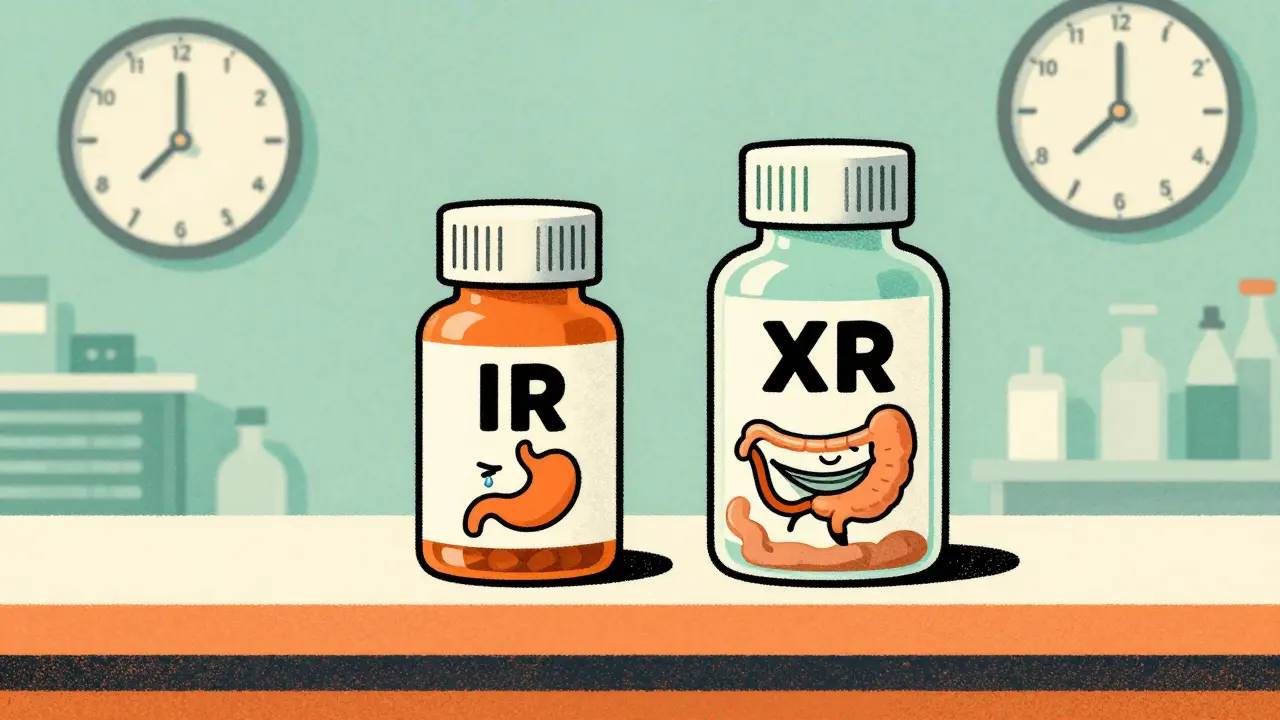
Metformin works by making your liver less greedy with sugar and helping your muscles use insulin better. But here’s the catch: it doesn’t just act where it’s supposed to. About 20 to 30% of people get gastrointestinal side effects because the drug irritates the lining of the gut as it passes through. The immediate-release (IR) version hits your system fast-peak levels in about 3 hours-so it dumps a concentrated dose into your upper intestine all at once. That sudden surge is what triggers nausea, diarrhea, and cramps in sensitive people.
Extended-release (XR) metformin is designed to avoid that. Instead of releasing all the medicine at once, it slowly leaks out over 8 to 12 hours. Think of it like a slow drip instead of a splash. That means less of the drug is hanging around in one spot at the same time, which reduces the irritation. It’s not magic, but it’s science that works for a lot of people.
The Numbers: How Much Better Is XR?
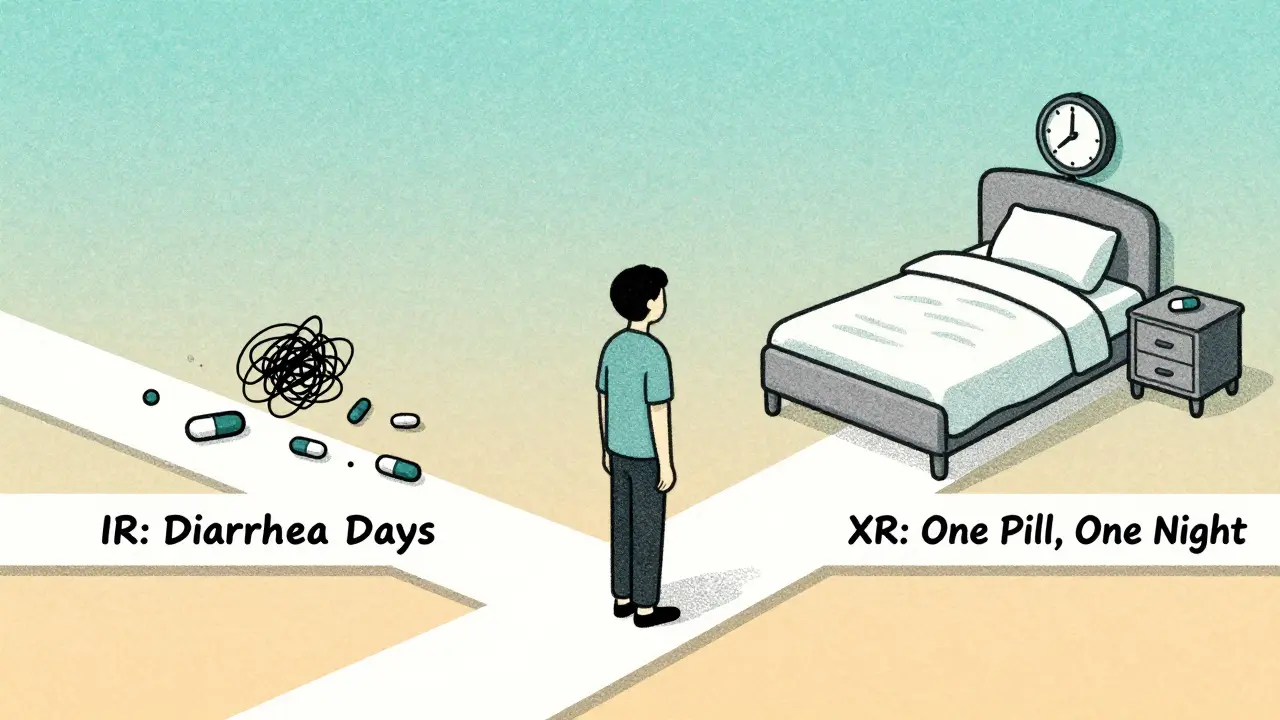
Let’s look at real data. In a 2004 study of patients who switched from IR to XR, GI side effects dropped by more than 30%. Diarrhea alone went from affecting nearly 29% of users to just 17%. Another large review in 2021, which looked at over 2,300 people across seven studies, found that XR cut overall GI problems by 15.3% compared to IR. That’s not a tiny difference-it’s enough to keep people on their medication.
But it’s not perfect. Some people actually get more nausea on XR. One study showed nausea jumped from 2.8% with IR to 4.6% with XR. Why? Because the drug is still in your system longer. If you’re sensitive to metformin, the prolonged exposure can cause different kinds of discomfort-not less, just different.
And then there’s patient feedback. On Drugs.com, metformin XR has a 6.9 out of 10 rating. Metformin IR? Only 5.8. On Reddit, one user wrote: “After years of daily diarrhea with IR, XR cut my symptoms from 5-6 days a week to maybe once a month.” Another said: “I switched and got worse nausea. Went back to splitting my IR dose-better results.”
So the data says XR helps most people. But not everyone. And that’s okay. What matters is what works for you.
Cost, Convenience, and Adherence
XR is usually more expensive. Generic IR costs about $8 to $15 for a 30-day supply. Generic XR? $10 to $20. That gap has shrunk since 2020, but it’s still there. For people paying out of pocket, that extra $5 to $10 a month adds up.
But here’s the twist: people who take XR are more likely to stick with it. A 2022 analysis of nearly 19,000 patients found that those on XR stayed on their medication 18.3% longer than those on IR. That’s not just about feeling better-it’s about staying healthy. Missing doses means higher blood sugar, which raises your risk of nerve damage, kidney problems, and heart disease.
And convenience matters too. IR usually needs to be taken two or three times a day with meals. XR? Once daily, preferably with the evening meal. Fewer pills. Fewer reminders. Less chance of forgetting.
How to Try XR (If You’re Struggling with IR)
If you’re on IR and your stomach is wrecked, don’t just quit. Talk to your doctor about switching. But don’t just swap the pills. Do it right.
- Start low: If you’re on 1000 mg of IR twice a day, switch to 1000 mg of XR once a day. Don’t double up.
- Take it with food: Always. Even if you’re on XR. Food slows absorption and reduces irritation.
- Go slow: Don’t jump to the full dose. Start with 500 mg XR once daily for a week, then increase by 500 mg every 7 days. This cuts initial side effects by over 40%.
- Give it time: It can take 4 to 6 weeks for your gut to adjust. Don’t give up after 3 days.
Some people do better splitting their IR dose-say, 500 mg with breakfast and 500 mg with dinner-instead of switching to XR. That’s also a valid option. The goal isn’t to pick the “best” pill. It’s to find the one you can take without feeling sick.
What the Experts Say
The American Diabetes Association and the UK’s NICE both say: if you can’t tolerate IR, switch to XR. The American Association of Clinical Endocrinologists even calls XR the preferred choice. But the European Association for the Study of Diabetes is more cautious. They say the benefit is real-but small. For some, it’s worth it. For others? Not enough to justify the cost.
Here’s the bottom line: if you’re struggling with GI side effects, XR is worth trying. It’s not a miracle. But it’s the best tool we have right now to make metformin bearable.
What’s Next? New Formulations Coming
Researchers aren’t done. In 2023, the FDA approved a new XR version called Metformax XR, which uses pH-sensitive tech to release the drug even more gently. Early results suggest it reduces GI issues another 12-15% compared to older XR pills. That’s promising.
And there’s a big 24-month study still underway-MET-XR-that’s tracking over 1,200 people to see exactly how much better XR is over the long term. Results are due in mid-2024. We’ll know more then.
For now, the message is simple: if your stomach hates metformin, you’re not alone. And you don’t have to suffer through it. Extended-release isn’t the answer for everyone-but for a lot of people, it’s the difference between managing diabetes and quitting the drug.


Alfred Schmidt
I’ve been on metformin IR for 5 years, and I swear, my gut was a war zone-daily diarrhea, cramps like I’d been kicked by a horse, nausea so bad I’d skip breakfast just to avoid throwing up. Then I switched to XR. Not magic, but it’s like someone turned down the volume on my intestines. Now I go a whole week without a single incident. If you’re suffering, DO IT. Your colon will thank you.